


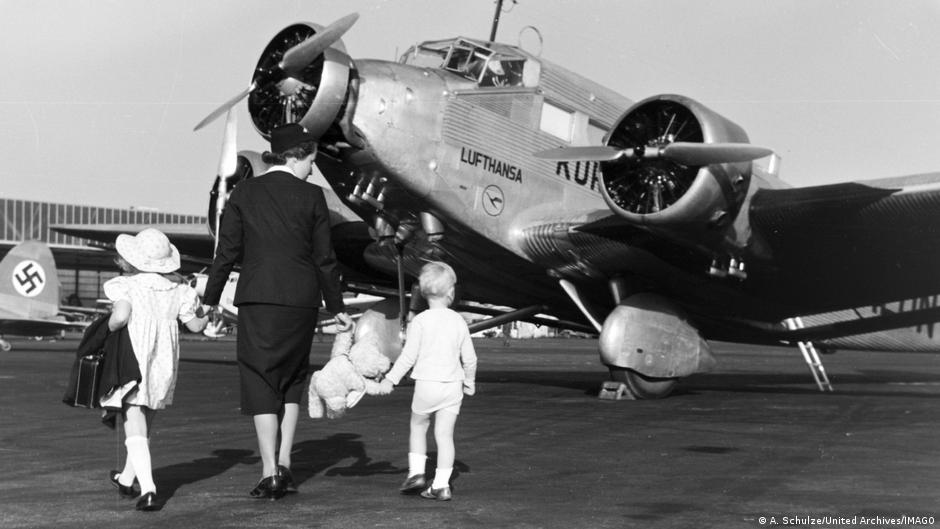
Lufthansa Airlines, the flag carrier of Germany, takes great pride in its aviation heritage spanning almost a century. Images from the 1920s and 1930s — including Junkers Ju 52 aircraft used by the Luftwaffe — feature prominently in Lufthansa’s marketing, alluding to the “pioneering spirit” of the brand and its place in aviation history.
But the story of Lufthansa’s role in the Third Reich war machine, one that includes the large-scale use of forced labor, remains largely under the radar. In fact, Lufthansa is just one of many companies that collaborated with the Nazi regime, big-name brands and business dynasties that continue to “hide in plain sight,” according to journalist David de Jong.
He is the author of the 2022 book, “Nazi Billionaires: The Dark History of Germany’s Wealthiest Dynasties.” It charts how, unlike the high-ranking Nazi politicians and military leaders tried at Nuremberg, the majority of business leaders who cooperated with Adolf Hitler’s regime were never really held accountable.
The book includes Günther Quandt and his son Herbert, patriarchs of the dynasty that today controls BMW, and the industrialist Friedrich Flick, who was convicted of using forced and slave labor at Nuremberg. After his early release from prison in 1950, Flick became the largest shareholder in Daimler-Benz.
“There was no incentive on the side of the West German authorities to judge their fellow compatriots on crimes that they had committed themselves or bore responsibility for, or sympathies that they had held, or still held themselves,” de Jong told DW. “Denazification is a myth on every level of German society.”
After Germany’s defeat, the focus quickly turned to the nascent Cold War, to combating communism and Soviet Russia. West Germany was seen as capitalist bulwark and German businessmen were allowed to keep their assets, whether they were legitimately theirs or whether they had been seized from Jewish businesses.
This was not confined to German industry, said historian Peter Hayes, who points to how West Germany’s first postwar chancellor, Konrad Adenauer, demanded an end to denazification proceedings. The country needed experienced civil servants and professionals, Adenauer argued. His government enacted amnesty laws in the early 1950s, reintegrating hundreds of thousands of former Nazis into German society, including the civil service and the judiciary.
“They get off lightly because it was useful to the Allies and it was useful to the Germans themselves,” Hayes told DW. “There was a willful amnesia that West Germans found convenient. It fit in with a way of compartmentalizing Nazism, which is to say all the bad things were done by this minority of fanatics, the rest of us were just taken in, we were lied to, and the real criminals were the people in the SS and the party leadership.”
In his 2025 book, “Profits and Persecution: German Big Business in the Nazi Economy and the Holocaust,” Hayes examines how big-name companies were complicit in some of the worst atrocities of the period, from the supply of Zyklon B gas (used to kill in gas chambers) by IG Farben, whose successor companies today include BASF and Bayer, to the processing of gold dental fillings wrenched from the victims’ mouths in Nazi concentration camps.
“They not only knew what they were taking part in, they were trying to make money off of it,” he said.
How Lufthansa became a front for Nazi rearmament
Deutsche Luft Hansa — from 1933 styled as Lufthansa — was founded in 1926 when only a small elite could afford to fly. By the early 1930s, it was struggling to survive. The Nazis “saved Lufthansa,” according to German historian Lutz Budrass, an expert in German aviation history. In 1933, Hermann Goering appointed Lufthansa director Erhard Milch to state secretary of what would become the Reich Aviation Ministry.
Under the Treaty of Versailles, which ended World War I, it was forbidden for Germany to have an air force. But with only minor restrictions on civil aviation, Budrass said that Lufthansa became a front for National Socialist rearmament. After 1941, Lufthansa had a prominent role in aircraft repair workshops behind the front lines and, unlike other companies, was able to directly procure forced laborers, including many children who were kidnapped from Nazi occupied territories across Europe.
When World War II ended, the Allies declared the airline part of the German air force and liquidated the company in 1951. Deutsche Lufthansa, today the world’s fourth largest airline by revenue, was founded as the Aktiengesellschaft für Luftverkehrsbedarf (shortened to Luftag) in 1953, acquiring the rights to the Lufthansa name and the famous crane logo in 1954.
But it wasn’t just the same name and logo: Many of the same men returned to its management board, including Kurt Weigelt, who led the economic department of the NSDAP Office of Colonial Policy. After the war, he was placed on a list of wanted war criminals and was eventually sentenced to two years in prison and a fine. But by 1953, he was the chairman of Lufthansa’s supervisory board and in retirement, became its only ever honorary board member.
At the end of the 1990s, Lufthansa hired Budrass to research its use of forced labor during the Nazi period. The study was completed in 2001 but Lufthansa did not publish it until 2016, and then only as a supplement at the back of a glossy illustrated history of the company. In response, Budrass published his own 700-page book — against Lufthansa’s wishes: 2016’s “The Eagle and the Crane: The History of Lufthansa 1926-1955” (“Adler und Kranich: Die Lufthansa und ihre Geschichte 1926-1955″).
In a statement to DW, Lufthansa asserted that it is not the legal successor of the company founded in 1926, writing that “the legal foundation of today’s Lufthansa was laid in 1953.”
Lufthansa acknowledged that the National Socialist era is part of its history and said it would be “using its 100th anniversary as an opportunity to critically reexamine its responsibility during the Nazi era and to further investigate it based on historical research.”
“Lufthansa have always tried to profit off of their long history, but when they are confronted with the fact that National Socialism is a part of that history, then they always say, ‘No, that has nothing to do with us,'” Budrass told DW. “That for me has always been the problem with Lufthansa.”
Justice delayed, denied for victims of forced labor
The issue of Lufthansa’s Third Reich operations resurfaced in the 1990s when a cascade of class action lawsuits in the US brought by former forced laborers against German companies brought the issue to wider public attention.
The German government and industry heavyweights — including Lufthansa, Kühne + Nagel and Volkswagen — eventually bowed to international pressure and established the Foundation for Remembrance, Responsibility and Future (Stiftung EVZ) to provide compensation in 2000.
But since most of the over 20 million former forced laborers in the German Reich and the territories it occupied had already died by then, only 1.7 million received financial support from the EVZ.
It has now become almost standard practice for major German companies to hire historians to research their dealings during the Third Reich: Allianz, BMW, Dr. Oetker, Deutsche Bank and Volkswagen have all done so.
However, de Jong said those studies are usually destined to sit gathering dust in company archives, and in some cases are never made public at all. “On a consumer level you can say we had it all figured out, it’s here on the bookshelf. But the details are never really shown to the public,” he said.
Germany’s richest man, Klaus-Michael Kühne, is the “main example of the refusal to reckon” with this dark history, according to de Jong. Worth an estimated €38.7 billion ($44 billion), Kühne is heir to the global transport and logistics empire Kühne + Nagel. He also happens to be the largest single shareholder in Lufthansa.
Kühne + Nagel was co-founded by his grandfather August Kühne in 1890 and was run by the family and a Jewish partner Adolf Maass until 1933. That is when August’s sons, both Nazi party members, took control. Holocaust researchers point out that Kühne + Nagel had a virtual monopoly on the transportation of looted Jewish property, primarily furniture and artworks, from which it profited significantly during the Holocaust. Maass was murdered at Auschwitz in 1944.
Klaus-Michael Kühne does not like to discuss these matters. “For me, that chapter is closed, and I’m not going to reopen it,” he told Der Spiegel magazine in March 2025. The controversy had reignited after it was revealed that Kühne was the funder of a new opera house in Hamburg, leading to accusations of “whitewashing” the company’s dark past.
“The businessmen who I wrote about, they fought tooth and nail to keep the assets and the companies that they had robbed, and often were victorious,” said de Jong. “I think the bare minimum that one can ask for, it’s not monetary restitution at this point, but it is just taking moral responsibility for history.”
Edited by: Sarah Hofmann
