


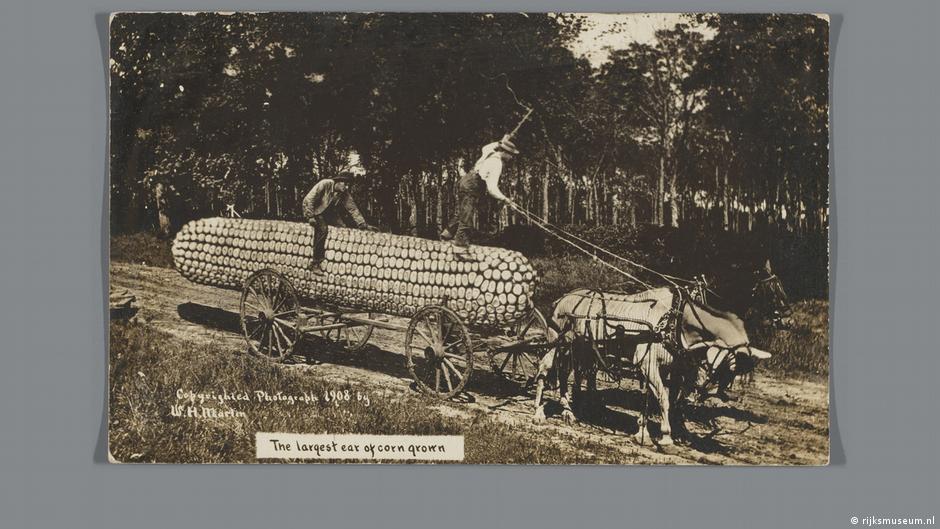
A tool of endless potential or a technology that threatens democracy via deepfakes? While AI-generated imagery has made its way into our everyday lives, its impact on society is still being explored.
The exhibition “Fake! Early Photo Collages and Photomontages,” which can be seen at the Rijksmuseum in Amsterdam until May 25, takes a step back from the ongoing discussion to remind us that images were faked and manipulated way before the invention of Photoshop or AI.
“As soon as photography was invented, some 187 years ago, images have been changed, altered, manipulated — sometimes for bad reasons, sometimes for just entertainment,” exhibition curator Hans Rooseboom told DW.
Different techniques, different motivations
The exhibition brings together 50 historical images from the museum’s collection. Originally published in various formats, including postcards, magazine covers and posters, the images feature a variety of manipulation techniques.
Multiple exposure photography, a creative technique that became popular shortly after photography was invented, made it possible to show, for example, the same person twice in a single image, as different areas of a photographic plate were exposed in different steps to create a single image.
In other cases, parts of negatives were combined to create surreal works, such as this photomontage of a man pushing a wheelbarrow containing an outsize head, an anonymous work dating back to circa 1900-1910.
The exhibition also explores the motivations behind the manipulated photos. “Some were made for political reasons, or for advertising, but most of them were made for entertainment purposes — and that must have been an extremely large market,” said Rooseboom, just like memes, cat content and other AI slop that floods the internet today.
Staged photography as a political weapon
However, some artists used creative techniques to communicate political ideas.
As early as 1870, brothers Eugene and Ernest Appert, who were Parisian portrait photographers, used photomontage techniques as propaganda tools. One of the two brothers created a series of photos called “Crimes of the Commune,” which emphasized the crimes of the Parisians who revolted against the new royalist-leaning government after the fall of Napoleon III.
The photos were inspired by real events, but Appert had staged them, using actors to recreate certain scenes and then cutting and pasting the headshots of the Commune’s central figures. The photos were later banned for disturbing public peace and promoting more violence, by sustaining anti-Communard sentiments.
Satirical anti-Nazi photomontages
In other cases of political commentary, collages didn’t aim to look realistic at all.
Helmut Herzfeld was a German artist who published his work under an anglicized version of his name, John Heartfield. A pioneer in the use of art as a political weapon, he created photo montages to promote his anti-Nazi and anti-fascist views.
Starting in 1930, Heartfield regularly created the covers for the weekly communist magazine Arbeiter-Illustrierte-Zeitung, or AIZ, which was based in Berlin until Hitler’s seizure of power in 1933. The left-wing magazine then went into exile in Prague.
In one of the AIZ covers on display at the Rijksmuseum, the chief of Nazi propaganda, Joseph Goebbels, is portrayed attaching Karl Marx’s iconic beard onto Hitler’s face. The magazine explains that Goebbels has convinced the “Führer” to wear the communist thinker’s beard when giving speeches to workers, in a desperate attempt to get the working class to adopt National Socialist ideas.
Readers understood this was satire, Rooseboom pointed out: “It was clear to everyone that he was not trying to make people believe that the scenes that he created were actually taking place.”
Yet the images were eye-catching at a time when mass media was just starting to spread. Starting in the 1930s, mass-media magazines were published in editions that sometimes reached millions of copies each week, said Rooseboom.
More than a lifetime of images in every scrolling session
Generally speaking, little is known about the reception of manipulated photos at the turn of the 20th century, said Rooseboom. What is clear is that people at the time weren’t exposed to that many images.
“Now, every single day we see more images or photographs than a 19th-century person would see in their whole lifetime,” he said.
Somewhat ironically, while people’s limited exposure to images in the past made it easier for them to be fooled by manipulated imagery, today we tend to scroll quickly through an overwhelming number of photos, often missing the details that would reveal an AI-generated fake.
Edited by: Cristina Burack
