

This is not the first conviction for Jafar Panahi. For decades, the filmmaker has experienced censorship and imprisonment in his home country of Iran. He never set out to be a political filmmaker.
“In my definition, a political filmmaker defends an ideology where the good follow it and the bad oppose it,” the Iranian director told DW earlier this year. “In my films, even those who behave badly are shaped by the system, not personal choice.”
But for more than a decade, Panahi, the winner of the 2025 Palme d’Or, the Cannes Film Festival’s top prize, has had little choice. Following his support for the opposition Green Movement protests, the director of “The White Balloon” and “The Circle” was handed a 20-year ban on filmmaking and international travel in 2010 by Iranian authorities. That didn’t stop him.
Over the years, he found new ways to shoot, edit and smuggle out his films — from turning his living room into a movie set (“This Is Not a Film”) to using a car as a mobile studio (in “Taxi,” which won the Golden Bear at the 2015 Berlinale).
Now, the award-winning filmmaker has been sentenced to one year in jail in absentia by the Iranian Revolutionary Court for engaging in “propaganda activities,” ISNA news agency reported his lawyer saying on Monday.
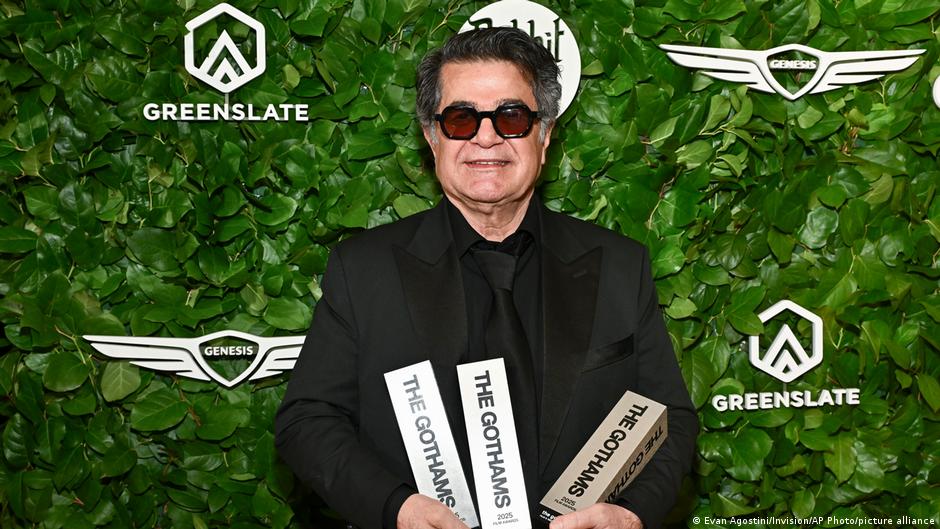
The court also imposed a two-year travel ban and prohibited Panahi from engaging in any political or social groups. On the same day, the director was at New York City’s Gotham Awards to receive three prizes for his films, including best director. His lawyer told media they plan to file an appeal. Panahi himself has not yet commented on the sentence, and has not said if he plans to return to Iran.
Earlier this year, for first time in over two decades, the now 65-year-old filmmaker returned to the Cannes Film Festival to present his latest feature, “It Was Just an Accident,” premiering in competition to an emotional eight-minute standing ovation.
From prison to the Palais
Panahi’s road to success has been anything but smooth. He was arrested in July 2022 and detained in Tehran’s notorious Evin prison. After almost seven months and a hunger strike, he was released in February 2023. In a stunning legal victory, Iran’s Supreme Court overturned his original 2010 sentence. Panahi was legally free, but artistically still bound by a system he refuses to submit to.
“To make a film in the official way in Iran, you have to submit your script to the Islamic Guidance Ministry for approval,” he told DW. “This is something I cannot do. I made another clandestine film. Again.”
That film, “It Was Just An Accident,” may be Panahi’s most direct confrontation yet with state violence and repression. Shot in secret and featuring unveiled female characters in defiance of Iran’s hijab law, the movie tells the story of a group of ex-prisoners who believe they’ve found the man who tortured them — and must decide whether to exact revenge. The taut, 24-hour drama unfolds like a psychological thriller.
Stylistically, “It Was Just An Accident” is a sharp break from the more contained, and largely self-reflexive works Panahi made while under his official state ban, but the plot remains strongly autobiographical.
A thriller that cuts deep
The film opens with a banal tragedy — a man accidentally kills a dog with his car — and spirals into a slow-burning reckoning with state-sanctioned cruelty. Vahid, played by Valid Mobasseri, is a mechanic who is asked to repair the damaged car. He thinks he recognizes the owner as Eghbal, aka Peg-Leg, his former torturer. He kidnaps him, planning to bury him alive in the desert. But he can’t be sure he’s got the right man, because he was blindfolded during his internment.
“They kept us blindfolded, during interrogation or when we left our cells,” Panahi recalls of his time in prison. “Only in the toilet could you remove the blindfold.”
Seeking reassurance, the mechanic reaches out to fellow prisoners for confirmation. Soon Vahid’s van is packed with victims seeking revenge on the man who abused them for nothing more than voicing opposition to the authorities. There’s a bride (Hadis Pakbaten) who abandons her wedding, together with her wedding photographer and former inmate Shiva (Maryam Afshari), to go after the man who raped and tortured her. There’s Hamid (Mohamad Ali Elyasmehr), a man so traumatized and so furious by his experience he doesn’t care if the man they’ve caught is the right guy; he just wants vengeance.
“Even dead, they’re a scourge on humanity,” he says of all the intelligence officers serving under the regime.
As the group debates vengeance vs. non-violence, alongside brutal descriptions of the beatings and torture they endured, Panahi inserts sly moments of humor and touches of the absurd. The hostage takers cross paths with Eghbal’s family, including his heavily pregnant wife, and suddenly find themselves rushing her to the hospital to give birth. Afterwards, as is tradition in Iran, Vahid heads to a bakery to buy everyone pastries.
“All these characters that you see in this film were inspired by conversations that I had in prison, by stories people told me about the violence and the brutality of the Iranian government, violence that has been ongoing for more than four decades now,” said Panahi. “In a way, I’m not the one who made this film. It’s the Islamic Republic that made this film, because they put me in prison. Maybe if they want to stop us being so subversive, they should stop putting us in jail.”
Filmmaking as the only option
Despite a career defined by resistance, Panahi insists he’s simply doing the only thing he knows how. “During my 20-year ban, even my closest friends had given up hope that I would ever make films again,” he said at the Cannes press conference for “It Was Just An Accident” in May.
“But people who know me know I can’t change a light bulb. I don’t know how to do anything except make films.”
That single-minded dedication is what kept him going, even at his lowest.
“I remember just before I was given this very heavy sentence of 20 years, banned from making films and from traveling, and I thought: ‘What will I do now?’ For a little while, I was really upset,” he recalled. “Then I went to my window, I looked up and I saw these beautiful clouds in the sky. I immediately got my camera. I thought: ‘This is not something they can take away from me, I can still take pictures of the clouds.’
“Those photos were later exhibited at the Centre Pompidou in Paris … There’s no way they can stop me from making films. If cinema is really what is sacred for you, what gives sense to your life, then no regime, no censorship, no authoritarian system can stop you.”
No exile, no escape
While many Iranian filmmakers have fled into exile — including Panahi’s close friend Mohammad Rasoulof, director of the Oscar-nominated “The Seed of the Sacred Fig,” who now lives in Berlin — Panahi said he has no plans to join them. “I’m completely incapable of adjusting to another society,” he said. “I had to be in Paris for three and a half months for post-production, and I thought I was going to die.”
In Iran, he explained, filmmaking is a communal act of improvisation and trust. “At 2 a.m., I can call a colleague and say: ‘That shot should be longer.’ And he’ll come join me and we’ll work all night. In Europe, you can’t work like this. I don’t belong.”
Edited by: Brenda Haas
This article was first published in May 2025 and updated by Sarah Hucal on December 2, 2025, to reflect Jafar Panahi’s sentence to one year in jail in absentia by the Iranian Revolutionary Court.
