


Since the war in Iran started, worries about oil and gas have made the biggest headlines and sparked the loudest complaints from consumers.
But another bottleneck in the global supply network is also causing alarm: a shortage of helium, an essential component used to make, among other things, semiconductors — those tiny chips that help run everything from electric vehicles to smartphones.
A prolonged shortage of helium could lead to a shortfall of advanced chips and have knock-on effects for electronics manufacturers who depend on them, or force others to scale back their datacenter plans.
Why is helium essential for chipmakers?
Considering that helium is colorless, odorless, and the second-lightest element in the universe, it has a surprising list of applications as a gas or in liquid form.
Helium is used in things like MRI scanning, optical fiber manufacturing, welding, leak detection, airbag inflation, not to mention balloons and dirigibles, says Phil Kornbluth, president of New Jersey-based Kornbluth Helium Consulting.
But it is the semiconductor chip industry that is sweating most right now.
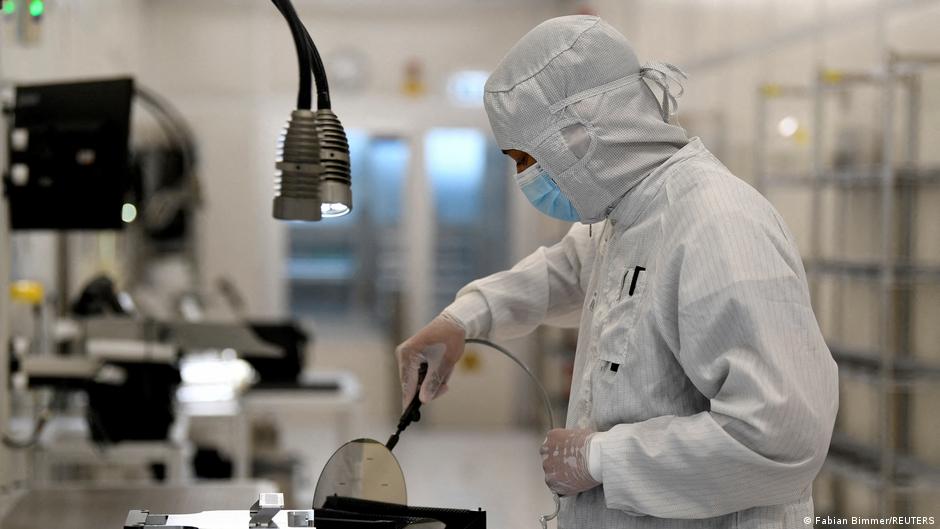
Semiconductor-grade helium is essential for chipmakers to maintain ultraclean and ultracold manufacturing environments. This contaminant-free helium is also needed for energy and heat transfer, and in vacuum chambers.
There is no alternative to ultra-high-purity helium for these chipmaking processes and without it, fabrication will slow down or even come to a halt.
“Helium is expensive relative to other gases, so, for the most part, where there are substitutes for helium, helium is no longer used,” said Kornbluth, who has over four decades of experience with commercial helium.
Where does helium come from?
Although there is helium in the atmosphere, most industrial helium comes from natural gas fields and is separated during processing, especially in liquified natural gas (LNG) extraction. In effect, helium is a byproduct of LNG production, which is the more profitable business.
There is an estimated 31.3 billion cubic meters (1.13 trillion cubic feet) of recoverable helium underground in the world, according to a US Geological Survey report published in early 2026.
The US has 8.49 billion cubic meters of recoverable helium, Algeria has 8.2 billion cubic meters and Russia has 6.8 billion cubic meters. Tiny Qatar has 10.1 billion cubic meters, the biggest deposit in the world and produced just over a third of the world’s helium last year.
Following the Iranian attacks, QatarEnergy stopped most of its LNG production in the country, which means helium production is also on hold.
At the same time, Iran has stopped ships leaving the Persian Gulf through the Strait of Hormuz, so one-third of global helium supplies are simply offline.
Moving and stockpiling helium
Handling helium is a specialized undertaking. Most helium is transported in bulk ultra-cold liquid form; the rest is moved around as a compressed gas.
As a gas, helium can be stored indefinitely, but the capacity for this is quite limited, says Kornbluth.
Another option is using underground caverns to store crude helium is large quantities, but capacity here is also limited. There are only four such privately owned storage facilities in the world — three in Texas and one in Gronau-Epe, Germany.
The majority of liquid helium storage facilities only have tanks that can hold a few days’ to a week’s worth of production, says Kornbluth, which is relatively small compared to overall production capacity, let alone growing industrial demand.
Tiny helium reserves and higher prices
For now, companies can count on reserves. And since it takes several weeks or more for helium to get from Qatar to its primary markets in Asia and Europe, “it should be at least several weeks before helium users feel the impact of a helium supply deficit,” said Kornbluth.
But since a significant portion of helium comes out of Qatar’s gas fields, a blockade of the Strait of Hormuz “means available helium volumes will be lower and prices higher,” said Michael E. Webber, a professor at the University of Texas at Austin who specializes in energy.
For Qatar, much will depend on how long the waterway is blocked and how fast helium shipments get back online. For customers like semiconductor manufacturers, finding alternative sources will not be easy, especially since a lot of helium is locked up in long-term contracts.
There are other places with untapped helium, but finding it and bringing it to the surface takes many months, says Webber. When it finally comes to the market, there is likely to be tough competition for it.
Semiconductors and sourcing helium
Last year, global semiconductor sales hit $791 billion (€687 billion), an increase of 25.6% compared to the previous year, according to the Semiconductor Industry Association (SIA).
With this growth comes an increased need for helium and the industry body has warned about risks to supplies.
Back in January 2023, the SIA pointed out that a sudden supply shock could significantly impact semiconductor manufacturing in the US and around the globe.
One of their biggest concerns was that much of the supply is concentrated in regions of potential geopolitical risk. As an added risk, specialized semiconductor-grade helium comes mainly from the Middle East and Russia.
Recycling helium is still in its infancy. And there isn’t much room to increase efficiency when it comes to the chipmaking business, since manufacturers have already taken steps to reduce helium consumption in response to previous supply disruptions, according to SIA.
For Kornbluth, the best way to reduce supply vulnerability is to purchase helium from suppliers who have diverse sources, even if that means having multiple suppliers.
Edited by: Rob Mudge
