


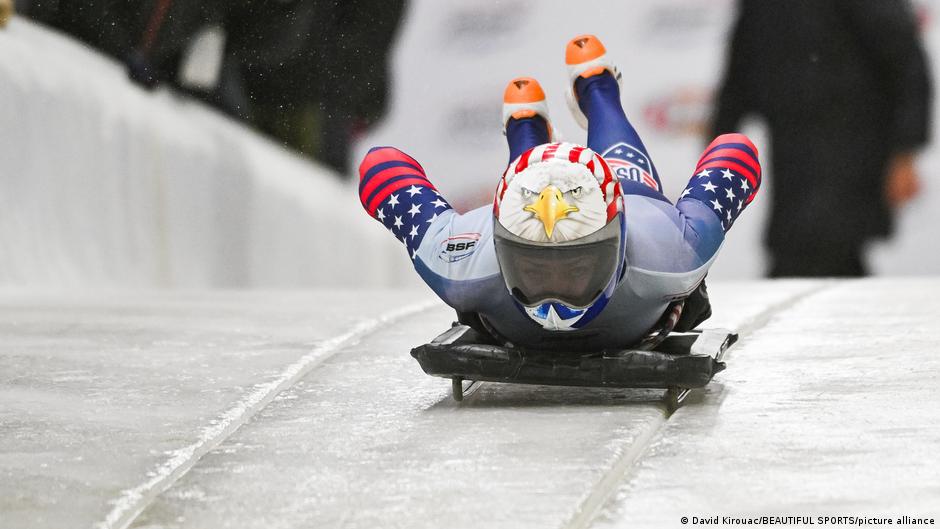
The International Olympic Committee (IOC) has rejected a request from the United States, which called for Katie Uhlaender, the skeleton athlete at the center of an Olympic qualifying controversy, to be given a discretionary place at February’s Winter Games at Milano Cortina, to “preserve” her Olympic dream.
Uhlaender, a two-time world champion, says she was unfairly denied the chance to reach her sixth Winter Games during a qualifying event in Lake Placid, New York, earlier this month.
She accused Canada’s skeleton coach, Joe Cecchini, of deliberately pulling his female racers out of the event, in a move aimed at depriving her and other athletes of vital Olympic qualifying points.
In a letter addressed to Kirsty Coventry, the president of the IOC, the US Olympic and Paralympic Committee (USOPC) said that Cecchini’s actions had “circumvented the Olympic qualification principles” and “undermined fair competition.”
An “amendment” to the qualification system, the USOPC said in the letter first revealed by DW, is “warranted in this moment given the exceptional circumstances […] that resulted in significant reputational harm to the sport across the world.”
“Specifically, allegations that another national federation delayed withdrawing four of its women’s skeleton athletes from the competition until they could not be replaced with other competitors,” Rocky Harris, the USOPC’s chief of sport and athlete services, wrote in the letter dated January 23.
However, on Monday, Harris told a press conference that the IOC had turned down the request, choosing instead to recognize the outcome of an investigation by the International Bobsleigh and Skeleton Federation (IBSF).
“We did send a letter to the IOC and we got a response this morning that they are supporting the international federation’s decision on the matter,” he said.
Uhlaender critical of IBSF investigation
Canada’s skeleton federation previously defended Cecchini’s actions as being “appropriate, transparent and aligned with both athlete welfare and the integrity of the sport,” before the IBSF subsequently cleared the Canadian team of wrongdoing on January 15, saying that no rules had been broken.
The IBSF did, though, remind athletes and coaches about the concepts of “fair play and ethical conduct” — a “slap on the wrist” according to one source — while suggesting it would adjust its rules for future events.
However, Uhlaender criticized the IBSF for failing to carry out a “proper” investigation. She said that she was not asked to provide evidence, including the recording of a telephone call that she had with Cecchini, in which, according to her, he admitted to his scheme.
In the recording, which has been heard by DW, Cecchini told Uhlaender that he needed to assess “what’s in the best interests of our program and my team, both psychologically and then with points […] We’ve had some crazy races that have not gone our way this year, and I could just eliminate any possibilities here.”
Asked by Uhlaender if he would seek to limit the points on offer, Cecchini replied: “That’s where I stand.”
On Saturday, Uhlaender said she was preparing to take her case to the Court of Arbitration for Sport, the world’s highest sports court, after the IBSF’s appeals tribunal rejected her request to restore full qualifying points to the event at Lake Placid on January 11.
“I am now focused on legally challenging what I believe to be a fundamentally flawed investigation and decision by the IBSF in a final attempt to earn my place at what would be my sixth and last Olympic Games,” she said in a statement.
Uhlaender ‘one of the best’ skeleton athletes
Uhlaender won at Lake Placid. But she only received 90 points for her victory, instead of the full 120 that would have been awarded if there had been 21 or more athletes taking part.
Because countries are limited to a maximum number of athletes per Olympic event, this meant that she was unable to catch up with her nearest rival on the US skeleton team, Mystique Ro.
Ultimately, Uhlaender missed out on making it to Milan-Cortina by just 18 points.
The USOPC said creating an “extra spot” for the 41-year-old to compete at the Winter Games would “uphold the value of fair play, as well as the primary goal of the qualification system, which is to enable ‘the participation of the best athletes.'”
Pointing to her position of 19th in the Olympic qualifying rankings, the USOPC called Uhlaender “one of the best athletes globally” and said that her participation “would strengthen the competitive field.”
It is rare for discretionary spots to be awarded. In 2023, Ukrainian fencer Olga Kharlan was given a guaranteed entry for the 2024 Paris Olympics by then-IOC President Thomas Bach, although she ended up qualifying in her own right.
The IBSF declined to comment.
This article was originally published on January 24, 2026. It was updated on January 27, 2026, to reflect the IOC’s response to the USOPC’s letter.
Edited by: Wesley Dockery
