


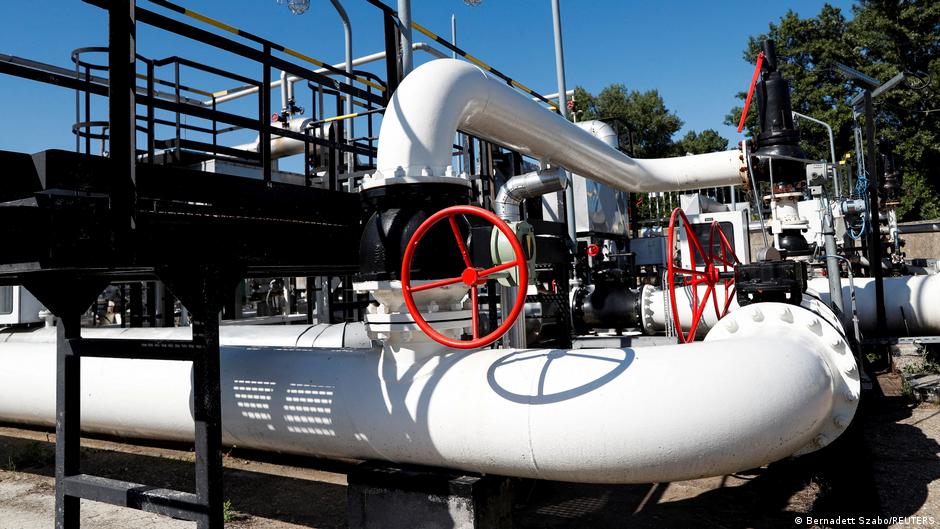
Hungary, Slovakia and Ukraine are in the midst of an spat over a key pipeline that supplies Russian crude to Central Europe.
Shipments through the Druzhba pipeline have stalled since the end of January.
While Ukraine blames a Russian drone strike for the disruption, Hungary and Slovakia slam Kyiv for the prolonged outage.
What to know about the pipeline?
The Soviet-era Druzhba pipeline carries Russian crude through Belarus and Ukraine and into Central Europe.
Opened in 1964, it is one of the largest oil pipelines in the world, connecting West Siberian oil fields to major refineries in Europe.
The pipeline has capacity to pump more than 2 million barrels per day but has been delivering only a fraction of it as most European countries turned away from Russian fossil fuels since Moscow launched its full-scale invasion of Ukraine in February 2022.
The Druzhba pipeline splits into two legs with the bigger, northern one going to Poland and Germany, while the southern leg supplies Slovakia, Hungary and the Czech Republic.
How much do Hungary and Slovakia rely on Russian oil?
Hungary and Slovakia are among the last remaining customers of Russian oil within the European Union, after other countries weaned off their dependence and diversified their supplies over the past four years.
The Druzhba serves as the primary conduit for Russian crude deliveries to the two landlocked nations.
They both hold exemptions to EU sanctions on Russian piped oil.
Their governments, which are viewed as the most Russia-friendly in the EU, have fiercely opposed EU moves to end those flows.
Budapest and Bratislava have also increased their dependency on Russian energy deliveries, relying on Moscow for 86-100% of their oil supply.
Russian crude deliveries via the Druzhba’s southern section stood at 9.7 million metric tons last year, with Slovakia receiving 4.9 million and Hungary some 4.35 million, Reuters news agency reported, quoting Ukrainian consultancy ExPro.
A report published in May 2025 by the Center for the Study of Democracy and the Center for Research on Energy and Clean Air (CREA), estimates that Hungary and Slovakia had paid Russia close to €5.4 billion ($6.36 billion) for crude oil deliveries alone since the start of the full-scale war.
What do Hungary and Slovakia accuse Ukraine of?
Oil deliveries through the Druzhba have remained cut off since January 27, when, according to Ukraine, a Russian drone strike damaged the pipeline.
Ukrainian officials say repair work is underway.
But Hungary and Slovakia blame Ukraine for the prolonged outage.
They accuse Kyiv of deliberately blocking supplies through the pipeline for political reasons.
Hungarian Prime Minister Viktor Orban described the oil supply disruption as a “Ukrainian oil blockade” and alleged that it’s aimed at driving up fuel prices in his country ahead of the parliamentary elections scheduled for April 12.
Orban claimed without providing evidence that Ukraine was interested in him losing the vote.
Slovakia’s Prime Minister Robert Fico, meanwhile, said the stalled oil supply was a “purely political decision aimed at blackmailing Slovakia over its international positions on the war in Ukraine.”
He threatened that Slovakia would halt emergency electricity supplies to Ukraine until Kyiv reopens the Druzhba.
Amid the dispute, Hungary on Monday vetoed a huge €90 billion ($106.11 billion) EU loan to Ukraine and blocked a new round of sanctions on Russia. The move was sharply condemned by Ukraine and EU leaders.
What’s Ukraine’s position on the issue?
Ukraine has long argued that continued purchases of Russian energy by Hungary and Slovakia help finance Russia’s war against Ukraine.
But Kyiv denies any responsibility for the Druzhba outage, saying Budapest and Bratislava should address their complaints to Moscow.
Ukraine has also slammed what it described as “ultimatums and blackmail” by its two Central European neighbors, and said they are “playing into the hands of the aggressor.”
“Statements from Budapest and Bratislava are provocative, irresponsible, and threaten the energy security of the entire region,” Ukraine’s Foreign Minister Andrii Sybiha said.
Are there any alternatives to the Druzhba pipeline?
Ukraine has proposed alternative transit routes to ship oil to Europe until the deliveries through the Druzhba resume.
Reuters reported that the Ukrainian mission to the EU proposed shipments through Ukraine’s oil transportation system or a maritime route, potentially including the Odesa-Brody pipeline linking Ukraine’s main Black Sea port to the EU.
The Adria pipeline — which runs from Croatia’s Adriatic coast to inland Central Europe — also offers an alternative. While Hungary’s Orban argues the Adria is only suitable as a backup, his Slovakian counterpart Fico says the pipeline’s capacity had never been tested, and the cost could be five times higher than for the Druzhba.
The CREA report, however, states that phasing out Russian oil is “fully feasible” for Hungary and Slovakia, and that the Adria pipeline “can meet their combined needs.”
Edited by: Ashutosh Pandey
