


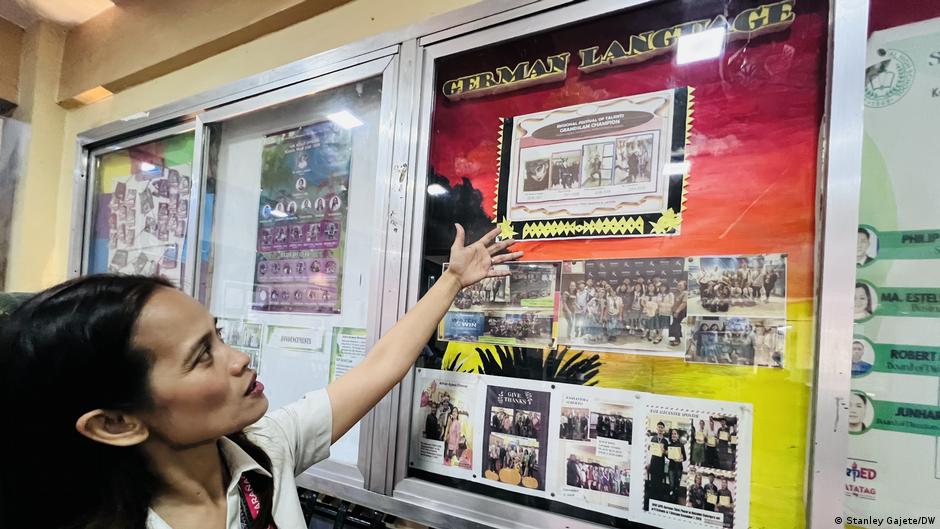
A German lesson is starting in a public-school classroom in the Philippines, and it opens with a greeting:
“Guten Morgen,” the teacher says. Students respond carefully, shaping unfamiliar sounds before moving on to short dialogues about directions, food, family and eventually, culture.
In a Philippine public school, that routine still feels unusual. German, after all, is more commonly associated with international schools or private language centers. But the language has quietly taken root in selected secondary schools due to a program launched by the Department of Education some 15 years ago with the backing of the local Goethe-Institut, an international organization cooperating closely with the German government.
Following a pilot project on foreign languages in 2009, the Department of Education updated its curriculum and launched summer training programs for German teachers with the help of the Goethe-Institut in 2011.
German language ‘a challenge,’ even for teachers
The partnership between the Philippines’ educators and the Goethe-Institut has changed many careers.
Marites Lacson, a longtime English teacher at Paranaque High School in Metro Manila, still remembers when the Department of Education memorandum first arrived. The authorities were offering several foreign-language courses, but German stood out to her — because she found it intimidating.
“I told my department head to offer it first to our experienced teachers,” Lacson told DW.
Some 600 teachers had applied for the 2011 program nationwide, and Lacson said she was “lucky enough” to be chosen and trained.
“I took it as a challenge,” she said. “I really put myself into loving the program because I now see it as an investment.”
The would-be German teachers had to attend an intensive course at the Goethe-Institut as part of their training.
“I believe the German language is one of the most difficult languages to be learned,” said Lacson, pointing to its logical but highly technical rules on spelling, grammar and syntax. At the same time, she believes those same rules train students to think carefully and systematically.
She also notes that the updated curriculum issued by the Department of Education put focus on globalization.
“Globalization means our students should be globally competitive when it comes to the workplace. One way to do that is to be language competitive,” she said.
Inside the Goethe-Institut partnership
From its base in Salcedo Village, Makati City, the Goethe-Institut Philippinen positions itself as a partner for language, education and cultural exchange, which includes their training of German teachers for public schools. The institute operates independently but is closely connected to the German Foreign Ministry and backed by Berlin in pursuing closer cultural and language relations abroad.
“We have a big part, what we call educational cooperation,” said Jens Rösler, head of the language department. “We cooperate with 21 high schools in the Philippines, including Paranaque High School, within a framework agreement with the Department of Education.”
Some of the teaching courses offer three to five meetings a week, while other groups meet just once, often on the weekends, to accommodate teachers’ schedules.
“It’s upon the discretion of [the Philippines Department of Education] to decide which schools, how many schools, and how many teachers they nominate for German classes,” explained Julian Christopher Fuchs, the institute’s director in the Philippines.
“We strengthen their level of German and their knowledge related to methodology, how to teach German and also up-to-date knowledge about Germany,” said Fuchs.
Thousands of exams taken every year
The partnership extends beyond high schools. The Goethe-Institut also works with the country’s top universities, including the University of the Philippines, Ateneo de Manila University, De La Salle University, and increasingly University of Santo Tomas.
In addition, it runs pre-integration language programs for Filipinos preparing to live and work in Germany, in coordination with the Department of Migrant Workers.
“At this stage, mostly anyone can enroll in our classes,” said Rösler, referring to the institute’s broader language offerings.
He added that some 2,200 students attend the courses each year, and the Goethe-Institut administers around 6,000 exams, roughly half of which are done online.
The Philippines’ authorities encourage SPFL-German students to take the Goethe-Zertifikat Fit in Deutsch 1, an internationally recognized A1-level exam in a push toward standardized, portable credentials.
Students need to know English to learn German
At Paranaque High School, German classes are offered to students who first demonstrate strong academic performance. Proficiency in English is one of the prerequisites before students are admitted into the program.
“When we introduced this to the learners, first and foremost we let them understand why we should have this,” Lacson said. “We also let them feel that it’s OK to find it difficult. We assure them we will be very patient.”
The approach seems to work.
Student Cheska Anne Macasinag said learning German is the same as any subject “as long as you put your passion into it and you really listen to the teacher’s lessons.”
Just recently, the school held an event to allow students to showcase German culture and language to their classmates.
Languages as ‘windows into new universes’
Globally, German remains a major foreign language. According to a 2020 survey, nearly 15.5 million people were learning German worldwide, and roughly 106,000 schools offered it, up from 95,000 in 2015.
“When you study a foreign language, you understand the person behind it,” said Rösler. “You can talk about any topic in English, but if you want to understand the person behind it, you need to know the language.
“Foreign languages help you analyze problems from different angles in very concrete ways.”
For Lacson, the rewards are personal.
“I had a student who is now taking a culinary course in college,” she said. “German helped him a lot, especially in understanding different cuisines and knowing other cultures.”
Fuchs said languages are “windows into new universes.”
“They enrich your life because you gain new perspectives, and in today’s complex world, that’s exactly what we need.”
Editor’s note: Deutsche Welle also offers a wide range of free online courses for English-speaking students and teachers, available here.
Edited by: Darko Janjevic
