


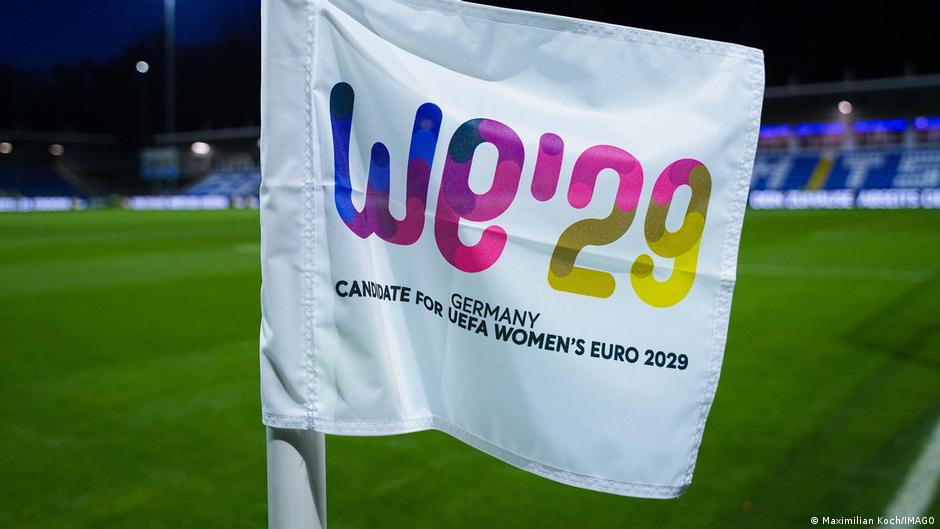
Germany is set to host the Women’s Euros in 2029. In a bid process that saw Italy and then Portugal drop out, Germany on Wednesday was victorious over bids from Poland, aiming to become the first eastern European nation to host a women’s tournament, and a joint bid from Denmark and Sweden.
In a ceremony that was refreshingly short, UEFA President Aleksander Ceferin appeared on stage in Nyon, Switzerland, to announce the successful bid — just five minutes after it started.
“It was a long journey and it’s not just all of us standing up here, but we had so many people working at the DFB to get this tournament. So, thank you to all the people who supported us at the DFB, the teams and elsewhere,” German FA (DFB) President Bernd Neuendorf said.
“I would like to thank all the others in this room, the other bidders, Poland and the Nordics,” he added. “We all invite you to come to Germany. It’s a tournament for all in Europe, not just for Germany. You all are welcome; we would like to see you all.”
Germany hosted the men’s Euros in 2024, but this is Germany’s first women’s tournament since the 2011 World Cup. The last women’s Euros was even longer ago, back in 2001, which was a tournament that Germany also won.
This news comes at a good time for women’s football. Just a day prior, Germany lost the Nations League Final to Spain, the team has shown a lot of promise under head coach Christian Wück. Also, at the end of October, the DFB promised to invest €100 million ($117 million) in the women’s game. The bulk of these funds are earmarked to increase the professionalization of the women’s Bundesliga, and the fruits of that work might well be seen by 2029.
A tournament for Europe
The slogan of the tournament is: “Together WE Rise.” Eight German cities are to host matches: Munich, Frankfurt, Cologne, Düsseldorf, Dortmund, Hanover, Wolfsburg and Leipzig. According to the DFB’s pitch, the tournament should promote women’s football in every corner of Europe and no country is to be left out.
DFB Vice President Heike Ullrich stressed that it would be a “very open tournament” and pledged that the German FA would use Euro 2029 to “to raise women’s football to a whole new level, for the world.”
A major factor in Germany winning the right to host the 2029 tournament may well have been the DFB’s pledge to make this the first Women’s Euros to turn a profit. This is based on its projection of more than a million tickets sold, financial commitments from each of the would-be host cities, and support from German business. UEFA lost an estimated €35 million on the 2025 Women’s Euros in Switzerland. By comparison, the 2024 men’s European Championship in Germany generated a profit of €1.3 billion.
