


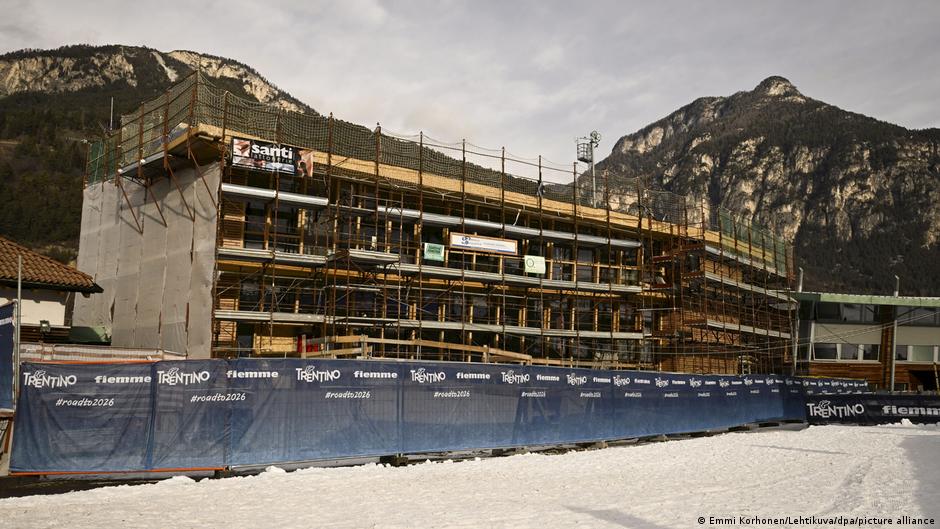
The build up to the 2026 Winter Olympics in Milan and Cortina have been far from ideal. The ice rink has been delayed and riddled with issues. The bobsleigh track has been controversial from the start. History shows that many Winter Olympic hosts have also been plagued by late construction completions and rising costs, but perhaps 2026 represents a tipping point.
“Quite frankly, this is inexcusable, especially for something like a multi-purpose arena,” Victor Matheson told DW, referring to the delayed ice rink.
“It might be a bit more understandable for specialized venues that need to be constructed specially for the Olympics, but from an economics perspective, if you don’t already have facilities in place, like a major indoor venue that can be used for hockey, you probably shouldn’t be bidding for the Olympics in the first place.”
Matheson is a professor of economics at the College of the Holy Cross in Worcester, Massachusetts, and his expertise lies in the economic impact of major sporting events.
The estimated budget for the 2026 Winter Olympics is north of $3.5 billion (€3 billion). Some reporting suggests there will be an economic boost of approximately €5 billion as a result of the Games, through tourism and infrastructure upgrades for example. That figure remains an estimate.
History also shows that sadly too many Games suffer from white elephants – the concept that expensive stadiums and facilities become unused over time. The question of whether hosting an Olympics is even worth it has been asked before, but perhaps this is the year it feels pertinent to finally address it.
Is it even worth hosting an Olympics in 2026?
“Local citizens and taxpayers have said again and again that while the Olympics are fun events, they don’t necessarily want to get stuck paying for someone else’s party,” Matheson said.
“Given the general lack of local support, countries where citizens have little say in the process will certainly be in a better position to host these events than vibrant democracies. That’s how the IOC (International Olympic Committee) ended up having to choose between Beijing and Almaty for the last Winter Games. And FIFA has now had World Cups in Qatar and Russia, and is going to Saudi Arabia in 2034.”
The International Olympic Committee is a non-profit organization, which means 90% the revenues from the Games go straight back into sport and athlete development, including aiding host cities. In 2018, it announced it would deliver $925 million for Milan-Cortina, slightly less than the $970 million it gave Beijing for the 2022 edition. But because of it’s structure, they are, in many ways, still very reliant on potential hosts.
“The IOC’s whole ‘Agenda 2020’ that committed the organization to a sustainable Olympics model (including sustainable economics), was not a choice based on benevolence but at last partly rooted in self-preservation,” Matheson said.
“The weird thing that people don’t realize is that the IOC really doesn’t have the money to put on its own events. It only has the history and the property rights to its name and the rings. It needs committed partners to actually host the Games.”
Local problems the real concern
In the case of Milan-Cortina, they found one but it was not a choice that came free of conflict.
“I think one important thing to remember for Milan-Cortina is that this is a circumstance where the problems are coming almost entirely from the local organizing committee not the IOC. The IOC has actually been quite willing to compromise in order to reduce the burden on local hosts in this case, for example suggesting that the hosts move the sliding events to Switzerland instead of spending huge sums on a new bobsled track in Cortina,” Matheson said.
“It certainly looks like pride got in the way of economics or efficiency at multiple points in this Games.”
One logical solution would be having a handful of rotating hosts, an idea that has been voiced for the last 20 years. This would dramatically cut costs. Choosing them though, is the hard part.
“[Donald] Trump has also exposed another flaw in that plan. Obviously, the hope might be to choose hosts (permanent or otherwise) that support human rights and democracy, ” Matheson said.
“But what do you do if one of your preferred hosts makes a rapid turn from social democracy into human rights abuses and authoritarianism?”
While such solutions appear unlikely to appear in the near future, multi-country hosting, as FIFA have done in the World Cup, can help share the load, reduce infrastructural investment and increase the likelihood of long-term facility use. Matheson is also impressed with some ideas that the organizers of the Summer Olympics in Los Angeles in 2028 have come up with.
“I am quite pleased with several of the steps being taken for the LA Games, in particular the move to increase the geographical footprint by moving softball to Oklahoma. This will reduce costs (by using existing sports and tourism infrastructure), expand access to fans, and increase revenue (by placing at least some events in areas with high demand for the sport),” Matheson said.
Edited by: Chuck Penfold
