



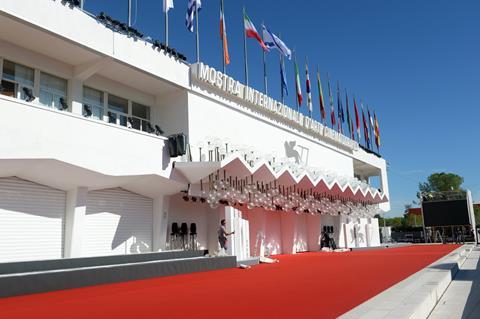
Italian and European film organisations have published a statement criticising the Venice Film Festival for the lack of Italian female filmmakers in its official selection, calling the lineup “one-dimensional” and “troubling”.
The statement, published in leading Italian newspaper La Repubblica, is signed by Italian filmmaking bodies 100autori and ANAC, directing organisation Air3, documentary group Doc/it and Women in Film Television & Media Italia as well as the European Women’s Audiovisual Network (EWA).
Scroll down for statement in full
It comes a few days after the Venice lineup was unveiled, featuring only one film made by a female director out of 20 titles in official competition.
The statement noted that seven male directors represent Italian cinema in competition and out of competition at the festival, but no female Italian filmmakers are selected. “It is a one-dimensional selection: entirely male,” said the letter.
It goes on to note that only two female Italian filmmakers are selected in official selection: Alina Marazzi and Anna Foglietta, whose films The Girl With The Leica and Una Storia respectively play in the festival’s Horizons sidebar.
“The hopes for a more balanced range of perspectives – one that better reflects the makeup of humanity – rest on the shoulders and in the eyes of Alina Marazzi and Anna Foglietta,” said the letter.
“We hold them in our thoughts with deep affection, together with the other women directors scattered across the programme, and with the hundreds of young women who enrol in film schools in every discipline, often surpassing their young male colleagues in numbers, talent, energy, urgency and creative power. Yet no admissions committee at these schools creates classes made up only of women; instead, they rightly seek a degree of human balance.”
Venice artistic director Alberto Barbera insisted in a Screen interview last week that the festival had been strict in terms of its selection process, focusing on quality as its key criteria. He added that the festival and female directors had suffered a backlash in the past after promoting certain films by women filmmakers to main competition.
The statement went on to challenge this ‘quality’ selection criteria. “The criteria by which we judge quality must themselves be continually questioned. When, year after year, the outcome is such a heavily unbalanced representation, we cannot simply conclude that women directors ‘are not good enough’. We must ask whether the tools through which we view cinema are still fit for the present day.”
The statement noted that it is eight years since Venice joined the major festivals in signing the 50/50 gender parity pledge, which committed it to transparency in selection committees, publishing submission statistics, and improving female representation.
“It is to that awareness and responsibility that we now appeal,” continued the statement. “Because a world governed by a male perspective is frightening. And it is also troubling that this festival continues to look at the world through eyes that are almost exclusively male.”
Statement on the Presence of Women Directors at the 83rd Venice International Film Festival
“When will they ever learn” — Pete Seeger
Seven male directors represent Italian cinema in competition and out of competition at the Venice Film Festival, on the festival’s main stage. It is a one-dimensional selection: entirely male.
The hopes for a more balanced range of perspectives—one that better reflects the makeup of humanity—rest on the shoulders and in the eyes of Alina Marazzi and Anna Foglietta, both selected for the Horizons section, which is itself part of the official selection. We hold them in our thoughts with deep affection, together with the other women directors scattered across the programme, and with the hundreds of young women who enrol in film schools in every discipline, often surpassing their young male colleagues in numbers, talent, energy, urgency and creative power. Yet no admissions committee at these schools creates classes made up only of women; instead, they rightly seek a degree of human balance.
“But what about quality?” you may ask. Where does quality fit into all this?
Quality is not some divine, neutral or objective category floating above history. We know full well that it is a concept that shifts and evolves, and that art is a battlefield of bodies, tears, blood and power—not a heavenly realm where the sexless angels of quality drift about. Every selection is the result of a particular perspective, a particular culture, an imagination, preferences, sensibilities, limitations, mistakes and a clearly defined editorial vision. To believe that quality can be separated from all of this is to ignore how the cultural canon is constructed and where art itself comes from.
Precisely for this reason, the criteria by which we judge quality must themselves be continually questioned. When, year after year, the outcome is such a heavily unbalanced representation, we cannot simply conclude that women directors “are not good enough.” We must ask whether the tools through which we view cinema are still fit for the present day.
In 2018, the Venice Film Festival signed the 50/50 by 2020 pledge, committing itself to greater transparency in its selection process and to fairer representation of women and diversity in decision-making. Eight years have passed since that commitment, and six years since the target date we set ourselves—a recognition that cultural change does not happen spontaneously, but requires awareness and responsibility.
It is to that awareness and responsibility that we now appeal.
Because a world governed by a male perspective is frightening. And it is also troubling that this festival continues to look at the world through eyes that are almost exclusively male.
To Alina, Anna and the other women directors, we wish every success. And, of course, the same to all our male colleagues, because we know that cinema—not only Italian cinema—needs them. But when will they—the selectors, critics, producers and distributors—learn that they need us as well?
Signatories:
- 100autori – Association of Italian Filmmakers
- ANAC – National Association of Filmmakers
- AIR3 – Italian Directors Association
- Doc/it – Italian Documentary Association
- EWA – European Women’s Audiovisual Network
- WIFTM – Women in Film Television & Media Italia
