


For the past year, countries around the world have been in panic mode as the United States added tariffs or threatened trade wars. The sheer uncertainty of President Donald Trump’s whims has added a real sense of urgency to the situation.
The old global trading order is gone, and the realignment is pushing countries into each other’s arms in new constellations.
China has seen much of the tariff headlines, but the US’s neighbors and biggest trading partners, Mexico and Canada, have not been spared.
Across the Atlantic, the European Union has been on the tariff roller coaster, too, and is questioning long-standing partnerships. The contempt that Trump threw at European governments at the World Economic Forum in Davos was yet another loud wake-up call.
A reliable trading partner in tough times?
To counterbalance US hostility, the EU has been trying to scrape together deals, and finalize others long in the making, to show that the bloc is a reliable trading partner and an alternative to the United States. But trade deals are notoriously complex and take time to put together even in the best circumstances.
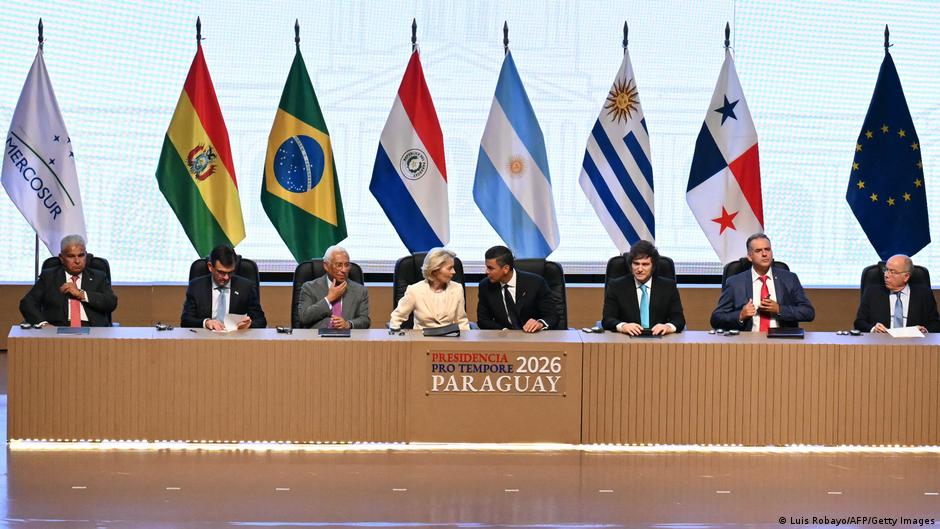
On January 17, European Commission President Ursula von der Leyen, went to Asuncion, Paraguay, to sign the EU-Mercosur trade agreement.
The deal between the 27-member EU and Argentina, Brazil, Paraguay and Uruguay, covers a market of 700 million people, making it one of the largest free trade zones in the world.
“We are sending a very clear message to the world that Mercosur and European Union countries are for low tariffs, for smooth trade, for creating better quality and better prices for our consumers,” EU Trade Commissioner Maros Sefcovic told DW after the signing.
But, four days later, the European Parliament halted the deal by voting for a lengthy review process by the European Court of Justice.
Even if parts of the deal are provisionally enacted, such hesitation is a major blow to the EU’s standing, and the South American partners may just withdraw from the deal in protest.
Trying to do it better in India
Ursula von der Leyen will be hoping for better luck at the EU-India summit on Tuesday in New Delhi.
At the meeting, which will be hosted by Indian Prime Minister Narendra Modi, it is expected that bilateral ties will be intensified.
The European Union is especially keen to finalize a free trade deal with the world’s largest democracy and the fifth-largest economy, after the US, China, Germany and Japan.
Negotiations on the EU-India Free Trade Agreement first started in 2007, were paused in 2013 and then restarted in 2022.
A breakthrough in talks would be consequential for both sides and cover a market of 2 billion people and a quarter of global gross domestic product.
The EU is serious about its commitments
Shouldn’t everyone be knocking on the European Union’s door?
The European Union is the world’s second-largest import market. Peter Chase, a visiting senior fellow in the Brussels office of the German Marshall Fund of the United States, tiold DW that many countries currently see the EU as “much more steady and reliable” than the United States.
“The EU is a good negotiating partner, in that it’s serious about the commitments it undertakes in its trade agreements,” Chase said. “And it definitely wants to build new trading relations with many countries.”
Still, long timelines and complicated ratification regulations can get in the way.
Political interests can also put up roadblocks, said Chase, whose work focuses on the European Union’s economic relations with third countries. The EU-Mercosur deal is an example of a small minority slowing progress.
EU trade agreements are piling up
The EU already has preferential trade agreements with 76 countries, and has shown renewed interest in joining the so-called Comprehensive and Progressive Agreement for Trans-Pacific Partnership — a free trade bloc of 12 Asia-Pacific nations, including only the UK from Europe so far.
In 2025, the European Union was able to negotiate an update to its trade agreement with Mexicoand finalized negotiations for a trade and investment agreement with Indonesia.
Agreements with Malaysia, the Philippines and the United Arab Emirates are being negotiated.
Furthermore, the EU-UK Trade and Cooperation Agreement is up for review this year, the first full review of the accord since it went into force in 2021. Though the audit is merely meant to look at implementation, some are hopeful it can help repair a strained relationship and serve as a springboard for closer cooperation.
Chase said there was something more pressing than another EU trade agreement: the World Trade Organization.
Though trade liberalization is good, he said, what the world needs is for the overall rule of law to be reestablished.
“Only the EU can help build the coalition of countries that will be needed to do this,” Chase said, in order to push back against both “America’s breaking of its commitments and China’s long-standing refusal to keep the promises it made when it joined.”
Edited by: Uwe Hessler
