


The US Supreme Court’s dramatic decision on Friday to rule most of US President Donald Trump’s tariffs illegal has left the country’s trade partners trying to figure out what the verdict means for them.
Although Trump says he will press on with tariffs using other statutes, the ruling could halt his flagship trade policy and give countries and sectors affected by the tariffs an unexpected but welcome reprieve.
European leaders have cautiously welcomed the decision.
French President Emmanuel Macron welcomed the decision when speaking at an agricultural fair in Paris, saying, “It is good to have power and counterweights to power in democracies.” He said France would consider the consequences of the new 10% global tariff announced by Trump.
The German government said it was in “close contact with the American government to obtain clarifications on the next steps.” A trade spokesperson for the European Commission said the 27-nation bloc was in “close contact” with the US administration as they seek clarity on the next steps.
Uncertainty over EU-US trade deal
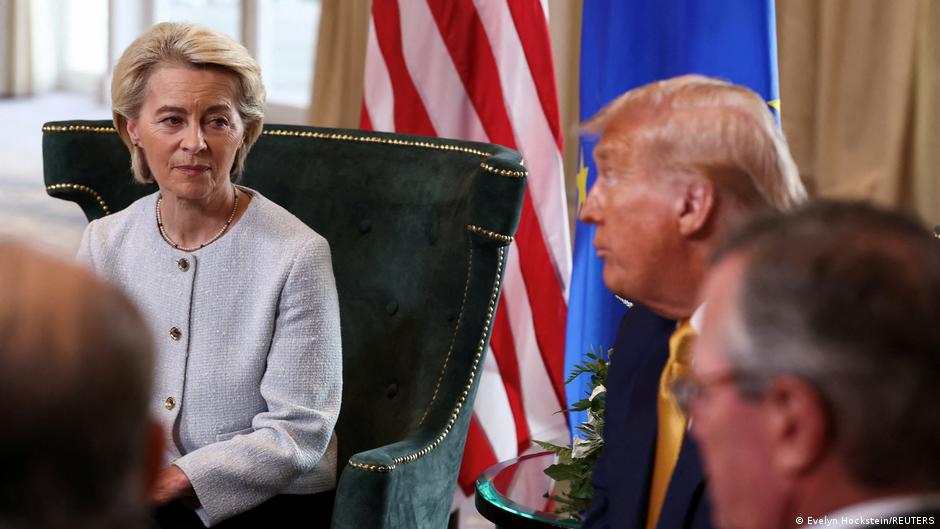
The verdict has created deep uncertainty over the EU-US trade agreement struck last July. EU lawmakers had paused the ratification process of that deal after Trump’s threats to annex Greenland, but the European Parliament’s trade committee is due to vote on the deal this coming Tuesday (February 24).
That vote is now in doubt, and EU lawmakers will hold an emergency meeting on Monday to discuss the next steps. “The era of unlimited, arbitrary tariffs … might now be coming to an end,” Bernd Lange, chairman of the trade committee, said on X. “We must now carefully evaluate the ruling and its consequences.”
That deal, struck in the wake of Trump’s so-called ‘Liberation Day’ tariffs, saw tariffs on most EU goods entering the US fixed at 15%, while the EU agreed to eliminate tariffs on all US industrial goods imported into the EU. Ratification of the deal, widely criticized for being uneven, was expected in March or April, but the Supreme Court decision has left the entire timeline and process in doubt.
“As the EU had put the ratification of its part of the US-EU deal on hold after the Greenland conflict, some European members of parliament might now feel encouraged to continue doing so,” Carsten Brzeski, Global Head of Macro for ING Research, wrote in a note. “However, the truth is that the filled toolkit of other tariff options and the new US stance on geopolitics will keep US trading partners in check.”
US Trade Representative Jamieson Greer said the government would “honour” deals it had struck with the EU and others, and expected them to do the same. “For a year I’ve been telling them that regardless of the direction of this litigation, we will impose tariffs at levels that they agree to,” he told Fox News.
The UK government, which was the first to strike a tariff deal with the US after Trump’s tariff blitz, said it expected its “privileged trading position with the US to continue.”
“The UK government is working with the US to understand how the overturning of Donald Trump’s tariffs by the Supreme Court will affect the UK,” a spokesperson for Downing Street said.
Cautious reaction from German industry
Although the trade pact struck in July was seen by many analysts as uneven from an EU perspective, it had been welcomed by industry leaders, given that it had brought a degree of certainty.
German business leaders have reacted with hope to the latest developments but say the need for clarity remains.
The Federation of German Industries (BDI) said the Supreme Court ruling was a strong signal for the rules-based trade order but noted that continuing uncertainty over the terms of trade would complicate business for internationally-oriented firms.
“The European Union, with the support of the German government, should quickly approach the United States and clarify the consequences of the recent ruling for the EU-US trade deal. Businesses urgently need planning certainty,” said Wolfgang Niedermark, a member of the executive board.
The German Chamber of Industry and Commerce (DIHK) said uncertainty remained high due to the chance of Trump using other methods to level tariffs. “The US administration still has other instruments for restrictive US trade measures, and German businesses must be prepared for that,” said Volker Treier, DIHK’s Head of Foreign Trade.
He said it was vital that the EU continued to press for the removal and reduction of tariffs outside the 15% rate, for example, the 50% rates levied on European steel and aluminum.
How different sectors could be hit
The Supreme Court’s decision specifically targeted the tariffs Trump enacted under the International Emergency Economic Powers Act (IEEPA), which he used for most of his so-called reciprocal tariffs.
However, some of the industry-specific tariffs that he has imposed in sectors such as steel, aluminium, and automotive were enacted on national security grounds. These tariffs have not been impacted by the Supreme Court ruling. The tariffs imposed on Chinese goods under Section 301 of the Trade Act of 1974 during Trump’s first term also remain in force.
Then there’s the new tariff he ordered following the Supreme Court ruling. These global 10% levies were issued under Section 122 of the 1974 Trade Act. Those levies are in addition to sectoral tariffs already charged under different authorities.
Trump has also threatened to start new trade investigations, which could lead to an entirely new set of tariffs.
For instance, European car and car parts manufacturers were subject to a 15% tariff when exporting to the US after the EU-US trade agreement. However, with the future of the deal now in doubt, it is unclear what tariffs they would face. The Trump administration has set a broad rate of 25% on most car imports.
Another sector important to European interests is pharmaceuticals. Although tariffs in that sector have yet to take effect, Trump has repeatedly threatened huge levies. If they were eventually implemented, they would also be implemented under Section 232 of the Trade Expansion Act of 1962, which lets the president implement tariffs on national security grounds.
“Europe should not be mistaken, this ruling will not bring relief,” Brzeski said. “Instead, Section 301 and 232 investigations can target specific sectors more precisely than IEEPA’s broad-brush approach. Pharmaceuticals, chemicals, automotive components — all plausible candidates for the next round. The legal authority may be different, but the economic impact could be identical or worse.”
Edited by: Ashutosh Pandey
