


On January 5, the leader of Spain’s Andalusia region, Juanma Moreno, painted his face black to portray Balthazar, one of the Three Wise Men, during a parade in Seville as part of Spain’s traditional Epiphany celebrations — prompting activists and online commentators to call attention to racism. Historically, blackface — when a white person paints their face black in a racist caricature of a Black person — has been used to mock, stereotype and dehumanize Black people.
Moreno said in a post on X that it was an “honor” to represent the biblical character during the procession. Each year, floats pass through Seville and the Three Kings hand out sweets to the crowd during the Epiphany parade.
Early Christian texts describe Balthazar as African, and Renaissance paintings often depict him as Black. Yet this is no excuse for white Spaniards to paint their faces for the occasion of the Epiphany, say activists. They have called for the practice to end, advocating for Black actors to play the role.
An ongoing problem
It’s not the first time that Spanish leadership has come under fire for showing someone wearing blackface. In 2024, the Madrid mayor’s officedistributed a holiday video for the Epiphany that featured a white actor with his face painted black.
The video showed King Balthazar depicted by a white man wearing thick black makeup. In the video, the man addressed children watching and promised them presents while putting on a fake foreign accent and speaking with grammatical errors.
“It is obviously not the right person to feature in these videos. It’s a regrettable mistake on the part of the company charged with this activity,” Madrid’s deputy mayor, Maria Inmaculada Sanz Otero, told reporters at the time.
Signs of change in the Netherlands?
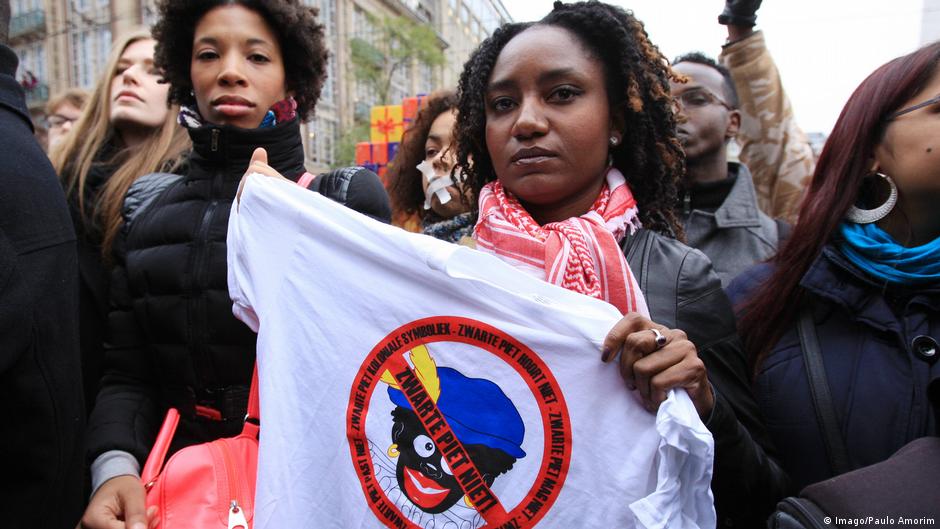
Perhaps the most well-known use of blackface in Europe is the “Zwarte Piet” aka “Black Pete” tradition in the Netherlands. Each year in November and early December, Sinterklaas, the Dutch figure based on Saint Nicholas, arrives in villages in a parade, bringing with him “helpers” known as Zwarte Piet (Black Pete), traditionally depicted as a character with dark skin.
Zwarte Piet is usually played by white Dutch people who paint their faces black, perhaps wearing curly black wigs, painting their lips plump and wearing gold earrings. For activists, this is clear-cut blackfacing, a racist display of Black people that should have long been abolished. Not only does it make Black people the target of mockery, the tradition can easily be seen as a symbol of the Netherlands’ colonial past — and the lack of historical reappraisal of it.
Defenders say that to stop portraying Black Pete would squash one of the Netherlands’ most prominent traditions.
Protests gained traction largely thanks to the work of Jerry Afriyie, a poet who founded the “Kick Out Black Pete” (KOZP) movement in 2010 to fight racism. He told the French news agency AFP in December that the group had achieved a major victory since then.
“Around this time of the year, you would pass hundreds of Black Petes, hundreds of white people in blackface. Today, it is different,” he told AFP. “Even small children are correcting me. When I say ‘Zwarte Piet,’ they say ‘Piet.'”
The movement’s goal was to “denormalize” Black Pete and the blackface tradition — and it seems to have worked to some extent. According to an Ipsos survey, the percentage of Dutch people who want to maintain the tradition has dropped to 38%, compared with 65% in 2016.
Every year, the movement held peaceful protests and faced aggression. Protesters have received death threats, been pelted with eggs and even fireworks by supporters of Black Pete.
Afriyie has pointed out that Black Pete was a figment of the imagination of author and poet Jan Schenkman, who popularized the story of Santa Claus in the Netherlands. Black Pete is “actually a black servant. He (Schenkman) himself said it. It’s a black servant serving a white master,” said Afriyie, pointing out that in this day and age, it is simply “unacceptable.”
Though a “huge step in fighting racism” has been made in recent years, Afriyie said, the Netherlands is still struggling with its colonial past and there’s more work to be done. “We are not there yet.”
