



Kevin PeacheyCost of living correspondent

 Getty Images
Energy bills are rising for millions of households in England, Scotland and Wales as the new year begins, after Ofgem raised its price cap slightly.
Prices for those on variable tariffs are rising by 0.2% from now, the equivalent to a £3 annual increase for a household using a typical amount of gas and electricity.
Campaigners say this means billpayers are facing another winter of high energy prices with the latest increase, albeit small, coinciding with the coldest period of the year.
However, changes announced in the Budget should mean a fall in the cost of energy from April.
Regulator Ofgem’s energy price cap sets the maximum price for each unit of gas and electricity for those on variable tariffs, not the total bill – so those who use more energy, pay more.
The regulator’s cap is illustrated with a household using a “typical” amount of 11,500 kWh of gas and 2,700 kWh of electricity a year with a single bill for gas and electricity, settled by direct debit. This household would see a £3 rise in its annual bill from £1,755 to £1,758.
However, the amount used varies significantly between households, so the best way to calculate the change is to work out the percentage change from your own usual annual bill.
Standing charges – the fixed costs that cover the cost of running the network as well as government levies – will rise by 2% for electricity and 3% for gas, driving the overall increase.
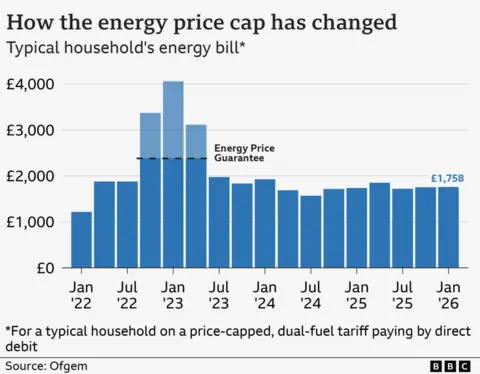
Electricity unit rates are rising, offset by a slight fall in gas rates, meaning that heavy users of electricity will see the biggest impact.
The price cap affects England, Wales and Scotland, as the sector in Northern Ireland is regulated separately.
Ofgem says people can often save money by moving to a fixed tariff. That sets the unit price for a certain period of time, so anyone already on a fixed deal will not see a change now.
Emily Seymour, energy editor at consumer group Which?, said there were several deals on the market at prices lower than the price cap.
“As a rule of thumb, we’d recommend looking for deals cheaper than the current price cap, not longer than 12 months and without significant exit fees,” she said.
For many households, the heating will be on for longer as we enter January and February, with snow and ice warnings in place for some areas.
Some vulnerable households in certain areas of England, Wales and Northern Ireland are receiving cold weather payments, worth £25 a week, if the average temperature in a local area is recorded as, or forecast to be, 0C or below for seven days in a row.
Households can check their eligibility via a government online service. A separate winter heating payment operates in Scotland.
The £150 Warm Home Discount has been extended by the government to apply to more lower income households.
Simon Francis, from the End Fuel Poverty Coalition, said more needed to be done to help those who were struggling following the latest, small price increase.
“This is a case of every little hurts… we need to see much lower bills but also measures to keep people’s homes warmer every winter.”
James Jones and his wife Christine, like millions of other pensioners, have seen their winter fuel payment reinstated following a government U-turn on restricting the allowance.
“Obviously we’ve got it for the cold months. We’ve got the central heating on more. It’s made a big difference. You know it’s coming, so it’s your standby,” said Mr Jones.

But the Warrington couple are still cutting back on luxuries to cover bills.
“We get a rise on our pension but it gets taken off you by food, petrol and everything else going up all the time so really you don’t benefit,” he said.
There is some hope on the horizon in spring, though. In the Budget, Chancellor Rachel Reeves said some levies placed on energy bills would go, lowering bills for millions of households by £150 a year from April.
That included cutting a scheme that was designed to tackle fuel poverty and help reduce carbon emissions, as well as shifting some costs onto general taxation.
People on fixed deals in April would still benefit from the changes, the government has confirmed.
However, about £30 will be knocked off those annual savings from April to pay for maintaining gas networks and strengthening the electricity transmission network.
There are also signs of lower wholesale costs, paid by suppliers.
Analysts at energy consultancy Cornwall Insight predict an 8% drop in the price cap in April – the equivalent of a fall of £138 to £1,620 a year for a household using a typical amount of gas and electricity.
