


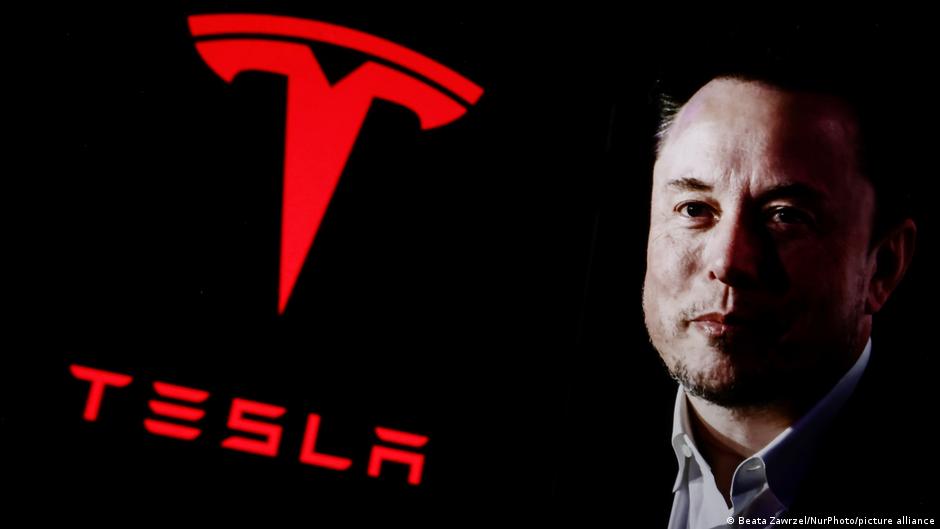
Elon Musk, who this week topped Forbes‘ Billionaires list for the second year in a row, is on course to become the world’s first trillionaire.
On top of his extreme wealth, Musk is bound to remain in the spotlight due to his polarizing views, including his active support for Germany’s far-right Alternative for Germany party.
His Tesla plant near Berlin also recently made headlines, as a works council election that concluded on March 4 left the factory non-unionized. Germany’s largest union accused Tesla of intimidating staff. Ahead of the vote, Musk himself warned that if the union gained influence, the expansion of the factory, which has around 10,000 employees, could be jeopardized.
Musk is “a declared opponent of any kind of union organization in his companies,” filmmaker Andreas Pichler told DW. “He wants total control over them and the conditions under which people work there.”
Pichler is currently giving talks in German cinemas, promoting his new documentary, “Elon Musk Unveiled – The Tesla Experiment.”
The film looks into how the billionaire pushed his self-driving Tesla car models, regardless of the human impact linked to safety issues previously flagged by the firm’s experts.
Threatened for speaking up
The documentary combines interviews with whistleblowers and former employees fired for expressing their concerns, as well as victims of Tesla accidents.
Among the whistleblowers is Lukasz Krupski, who leaked a trove of 3,000 customer complaints to German newspaper Handelsblatt in 2023. In those thousands of cases, drivers reported that their autopilot-equipped Tesla had accelerated on its own, or suddenly braked, leading to crashes.
Before becoming a whistleblower, Krupski had attempted to raise the alarm within the company. But Tesla insisted on keeping everything under cover, and Krupski said he was harassed, threatened and eventually fired for noting the major safety problems.
A David versus Goliath legal battle
Also portrayed in the film is the Benavides family from Florida, who sued the car manufacturer after 22-year-old Naibel Benavides Leon was killed in a crash involving a Model S Tesla.
Unlike many other victims, the Benavides family refused to settle out of court, undertaking years of legal battle.
A landmark verdict was reached in 2025, six years after the tragic accident. Tesla, found to be 33% responsible for the crash, has been ordered to pay $243 million to the victim’s family. The carmaker’s attempt to overturn the verdict was rejected by a federal judge in February 2026. Tesla is expected to appeal.
The Benavides case has inspired other victims to take on the billionaire’s company. “Several proceedings are now underway; there are no court rulings yet,” said Pichler.
Exploring Musk’s motivations and psyche
While exposing various Tesla safety controversies, the documentary also looks into how Elon Musk moved from being a supporter of the Democrats under Barack Obama to becoming a fierce ally of Donald Trump.
The film also alludes to Musk’s “messianic” mindset and his mission to colonize Mars.
In his view, the autonomous driving system is designed to be safer than human driving in the long term; the accidents that might occur along the way are, in this sense, “negligible.”
Musk has publicly stated that his primary motivation for accumulating wealth is to fund a self-sustaining city of a million people on Mars by 2050.
The technology and AI that is being developed for Tesla is therefore seen as highly relevant to building autonomous robots that will be required to colonize the hostile environment of Mars.
Even though this could be understood as a way of saving humanity, people only play a minor role in this bigger picture, said the documentary filmmaker. Musk advocates a form of transhumanism that focuses on merging human consciousness with artificial intelligence to prevent humans from becoming “redundant.”
Pichler noted that this idea of transhumanism seems extremely compelling to many people. “There are apparently enough people in the world who fully believe that technology can solve everything,” he said. “And that’s a problem.”
Edited by: Brenda Haas
