


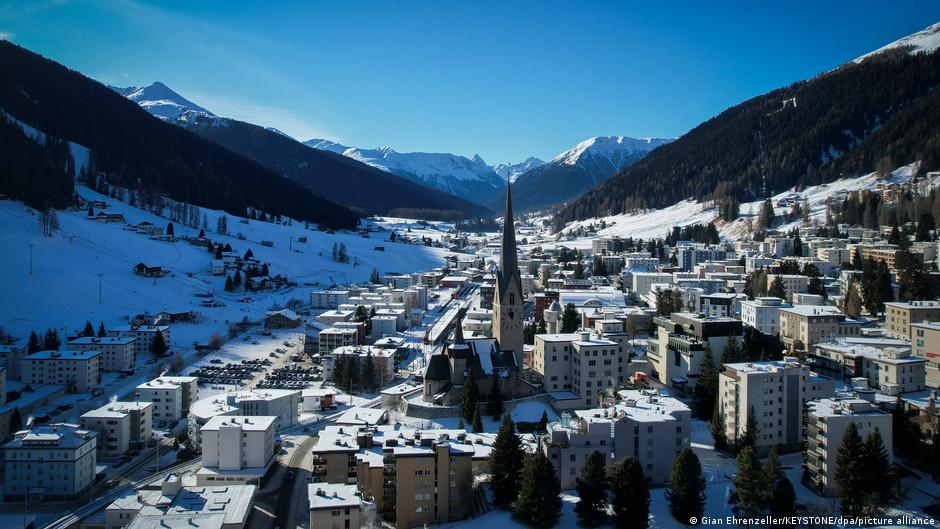
The Swiss Alpine town of Davos is once again welcoming the cream of the political, economic and cultural world for the annual meeting of the World Economic Forum (WEF).
The event is taking place at a time US President Donald Trump is seeking to dismantle the international order: From upending established trade rules and mass withdrawal from international organizations, including the UN climate treaty, to capturing Venezuela’s Nicolas Maduro following an attack on the capital Caracas and threatening to annex Greenland from close ally Denmark.
Trump’s assault on the international rules that have largely been in place since World War II, and its impact on the global peace, politics and the economy is expected to be among the key topics during the five-day event beginning January 19 under the theme A Spirit of Dialogue.
“Dialogue is not a luxury in times of uncertainty; it is an urgent necessity,” said Borge Brende, WEF President and CEO. “At a critical juncture for international cooperation — marked by profound geoeconomic and technological transformation — this year’s annual meeting will be one of our most consequential.”
Donald Trump will be joined by more than 60 heads of state and government, including German Chancellor Friedrich Merz, Canadian Prime Minister Mark Carney, Argentinian President Javier Milei, European Commission President Ursula von der Leyen, China’s Vice Premier He Lifeng, Pakistani Prime Minister Shehbaz Sharif and Syrian leader Ahmad al-Sharaa.
Largest US delegation ever in Davos
Trump is leading the largest US delegation ever to Davos, comprising five cabinet secretaries and other senior officials.
The delegation includes Secretary of State Marco Rubio, special envoy Steve Witkoff and Trump’s son-in-law Jared Kushner, setting the stage for high-profile discussions on Ukraine, Venezuela, Gaza and Iran, where eyewitnesses have reported a brutal crackdown on anti-government protests.
Trump is expected to meet with Ukrainian President Volodymyr Zelenskyy and Kyiv’s G7 allies — including leaders from Germany, Italy, France, the UK, Canada and the European Commission president — on the sidelines of the main event to seek US backing for security guarantees for Ukraine after a possible peace agreement with Russia, the Financial Times reported.
The strong US presence would be complemented by the first-ever “USA House” — a venue housed in a small church on the town’s main Promenade street, where US officials will host events and network with investors.
Geoeconomic warfare
While geopolitical upheavals and the ensuing uncertainty are expected to dominate discussions, policymakers and business leaders would be keen to discuss ways to deal with other challenges confronting the global economy.
The global economy has been relatively resilient despite heightened trade tensions and policy uncertainty, thanks in part to massive investments related to artificial intelligence (AI) in the US, which have propped up the world’s biggest economy.
But the projected global growth of 3.1% in 2026 is still not ideal, especially at a time when global debt has climbed to levels not seen since World War II.
The debt situation in several African countries is especially concerning, according to the International Monetary Fund (IMF).
Global trade remains under pressure as countries adopt increasingly protectionist policies, such as imposing unilateral tariffs, increasing restrictions on foreign investment and tightening supply on critical minerals.
Economic confrontation between nations and its consequences topped the WEF’s annual Global Risks Report released on Wednesday.
AI challenges and opportunities
Artificial intelligence is another focus this year, with several events and talks dedicated to the frontier technology, much like at recent WEF annual meetings. Top tech leaders such as Microsoft’s Satya Nadella, Nvidia’s Jensen Huang and Google’s AI chief Demis Hassabis will be at the event.
AI is already showing a lot of promise in fields such as medicine and education and has seen trillions of dollars worth of investments made or promised over the past few years, even though many companies are currently struggling to find real-world use cases for the technology that offer good value.
There are concerns about the technology’s impact on jobs, many of which are feared to become redundant in the next few years. Anthropic CEO Dario Amodei, among this year’s attendees, says that AI could eliminate half of all entry-level white-collar jobs in the next one to five years, underscoring a need for massive investment in reskilling.
AI risks worsening the existing digital divide, with poorer countries failing to capitalize on the opportunities. There are also concerns about AI models perpetuating existing biases, spreading misinformation, and generating deepfakes.
Misinformation and disinformation and cybersecurity are among the top global risks, according to the WEF risks survey, underscoring the need for effective regulations.
New leadership at WEF
This year’s meeting would be the first without WEF founder Klaus Schwab at the helm. The German-born economist resigned in April 2025, amid allegations that he and his wife used WEF funds for personal use. An independent inquiry, however, found no criminal misconduct, only minor irregularities.
Schwab has been succeeded by interim co-chairs Larry Fink, CEO of BlackRock, and Andre Hoffmann, vice chair of Swiss pharmaceuticals company Roche Holdings.
This year’s strong line-up of attendees comes as a boost for the organization after a tumultuous year. The organization that’s been around since 1971 to foster dialogue now faces headwinds as multilateralism wanes and free trade comes under fire.
Edited by: Uwe Hessler
