


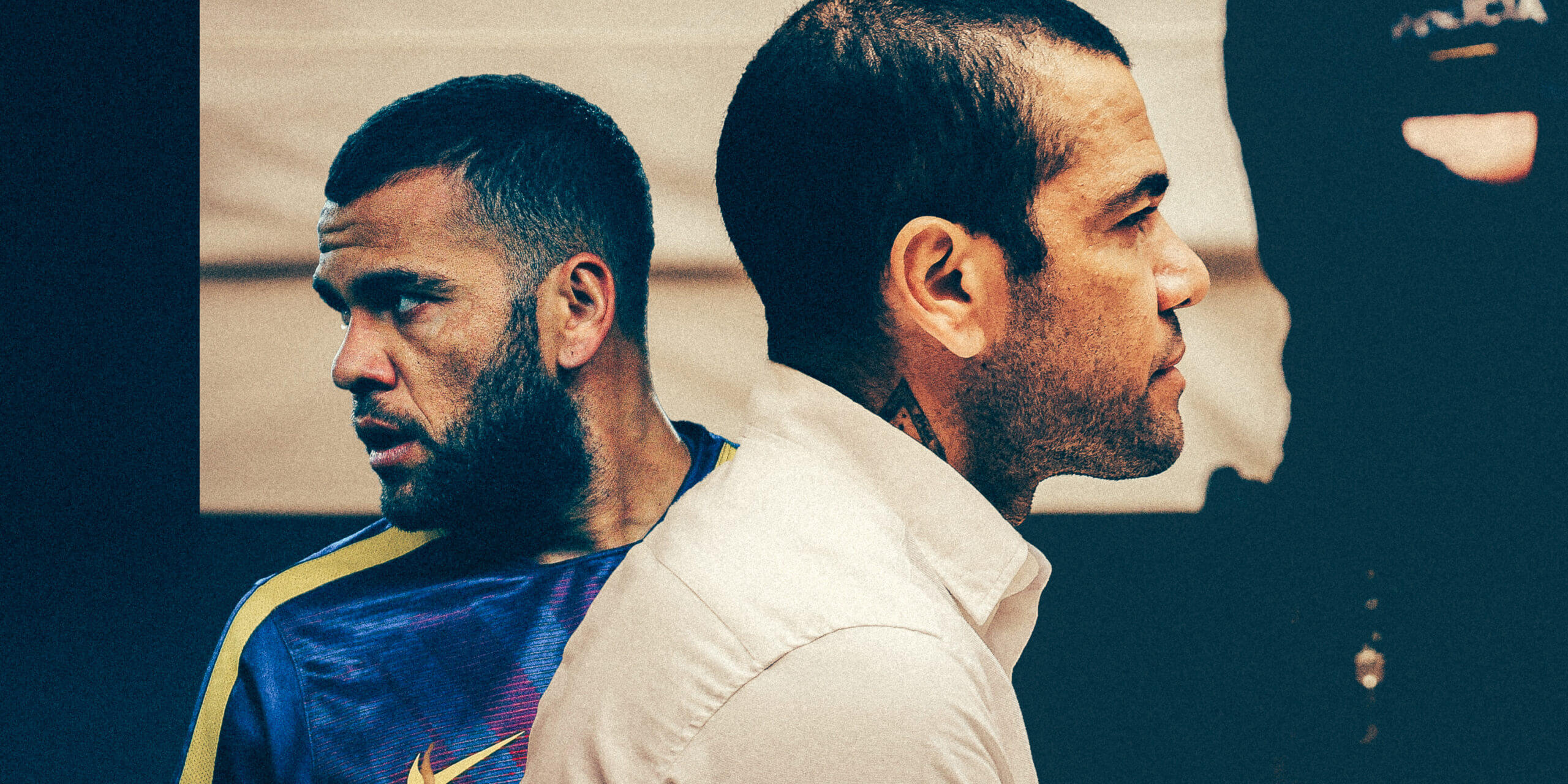
Dani Alves, who until recently was one of global football’s golden boys, was sentenced to four and a half years in prison this morning in Spain for sexual assault.
A dynamic and technically proficient right-back, he was an integral part of Barcelona’s side that set new standards in the European competition between 2008 and 2016. He made 126 appearances for Brazil during a 22-year career, winning 43 titles – an astonishing achievement that makes him the second most decorated footballer in history. Only his former team-mate at Camp Nou, Lionel Messi, has more trophies.
This success, combined with a relentlessly optimistic public persona, made Alves an extremely popular figure, almost universally popular. This partly explains why a three-day hearing in a Barcelona court earlier this month was dubbed the “trial of the year” by some sections of the Spanish media. Despite its voyeuristic undertones, the nickname does capture the shocking extent of Alves’ fall from grace.
On December 9, 2022, during the match between Brazil and Croatia at the Qatar World Cup, the then 39-year-old Alves was on the bench. Exactly six weeks later, he was arrested by Catalan police, accused of raping a 23-year-old woman in a private bathroom in a Barcelona nightclub on December 30, 2022.
Catalonia’s high court has now upheld the charges. “The court has no doubt that the complainant’s vaginal penetration was carried out with force,” the court wrote in a statement released after this morning’s hearing.
Alves has spent the past 13 months in a detention center about 25 kilometers northwest of Barcelona. A request for provisional release was rejected because he was considered a flight risk and there were no extradition arrangements between Brazil and Spain. After he is released from prison, he will be on supervised probation for another five years. He was also ordered to pay the victim €150,000 (£128,500; $162,700) in compensation and legal costs.
Alves began his career at Bahia, one of the biggest clubs in northeastern Brazil. At 19, he moved to Spain, joining Sevilla – initially on loan and later on permanently after winning the 2003 FIFA World Youth Championship with Brazil’s under-20 side.
Initially, there were doubts about Alves’s physical ability to compete in La Liga. His explanation of his stance, however, made skeptics reconsider. Alves is technically a defender, but defense is not his specialty. He is a free man, a de facto winger, just like his childhood idol Cafu.
Sevilla soon discovered that they had to harness this energy rather than contain it. Alves was encouraged to push forward and use his pace and technique in the final third. He helped the Andalusians win their first European trophy in 2006, scoring the first goal in the UEFA Cup final against Middlesbrough, and had the same impact in the title defense in 2007 force. A year later, he became a Barcelona player.
His first eight seasons at Camp Nou – and later a brief, largely forgettable return in 2021-22 – turned Alves into a superstar. During this time, he won six Spanish league titles, three Champions League titles and 14 other trophies, rarely missing a game. You’d be hard-pressed to find another full-back who could match his impact and consistency over the same period.
It helped that he arrived in Barcelona to coincide with the arrival of Guardiola. The Catalan’s possession-centric approach suits Alves perfectly and brings new nuances to his game. His partnership with Messi, in particular, is one of the defining characteristics of what many consider to be the best club side of the modern era.

Alves (right) won 23 trophies with Barcelona (Shaun Botterill – FIFA/FIFA via Getty Images)
Even after leaving Barcelona in 2016, Alves remained an outstanding figure. At 34, he reached another Champions League final with Juventus – Juventus defender Leonardo Bonucci called him an “alien” – and won the French title twice with Paris Saint-Germain. When he returned to Brazilian club football in 2019, joining Sao Paulo FC, 45,000 fans turned up at the Morumbi Stadium to welcome him.
He never replicated his success at club level with the national team, which is probably to be expected. Alves was a regular starter for Brazil for a long time, but oddly he only became a regular starter late in his career. He would have captained the Selecao at the 2018 World Cup, but missed the tournament due to injury. However, he wore the captain’s armband the following summer and led Brazil to victory on home soil.
Alves’ attitude – lively, cheeky and apparently carefree – has arguably won him more admirers than his ability. In a sport as deadly serious as football, a little personality can go a long way, and the Brazilian has always seemed determined to take his personality onto the pitch rather than leave it in the dressing room.
Over time, Alves grew into the role and became a full-time cultivator of his own image. He dabbled in modeling, released a single, and was into social media. Whenever he steps off the Brazil team bus, it’s like he has a tambourine or drum in his hand. He turned his description of his character (“so crazy”) into a catchphrase. Whenever he signed, he drew a smiley face inside the capital D.

Alves played for PSG from 2017 to 2019 (Aurelien Meunier/Getty Images)
Publishing lengthy first-person articles on the Players’ Tribune website has become a rite of passage for football players. Alves contributed two: one about his humble upbringing, and another reflecting on the pain of missing out on the 2018 World Cup. “Dani Alves won’t be playing in the World Cup,” one iconic line read, “but he’s still a happy bastard.”
Later, when he moved to São Paulo, the same website produced a seven-part documentary about Alves’ life. In one episode, he talks at length about his iconoclastic fashion sense, making faces for the camera while wearing a series of designer jackets. In another article, he discussed his relationship with music. Episode three follows Alves as he reconnects with his two children from his first marriage. It’s titled “The Family Man.”
Alves’s reputation is now in tatters like everyone else’s.
In early February, Catalonia’s High Court heard testimony from the victim’s friend, who was at the Sutton nightclub on the night of the incident, about Alves’ “despicable attitude”.While the victim’s testimony was released privately, her testimony – which has been previously reported Competitor Evidence from an early hearing detailed how Alves held her against her will in a toilet stall and penetrated her without her consent.

Alves was sentenced to four and a half years in prison (ALBERTO ESTEVEZ/POOL/AFP via Getty Images)
This morning, the court upheld this version of events, concluding that Alves “suddenly grabbed the complainant, threw her to the floor and, preventing her from moving, penetrated her vaginally, despite the complainant saying no , she wants to leave.”
The court said in a statement that “the injuries to the victim clearly showed the presence of violence that forced the victim to have sexual relations” and that “the defendant used violence to suppress the victim’s will.”
Defense attorneys plan to appeal the decision.
However, the seriousness of the verdict means it will be difficult to view Alves in the same way again.
(Photo: Getty Images; Design: Eamonn Dalton)
