

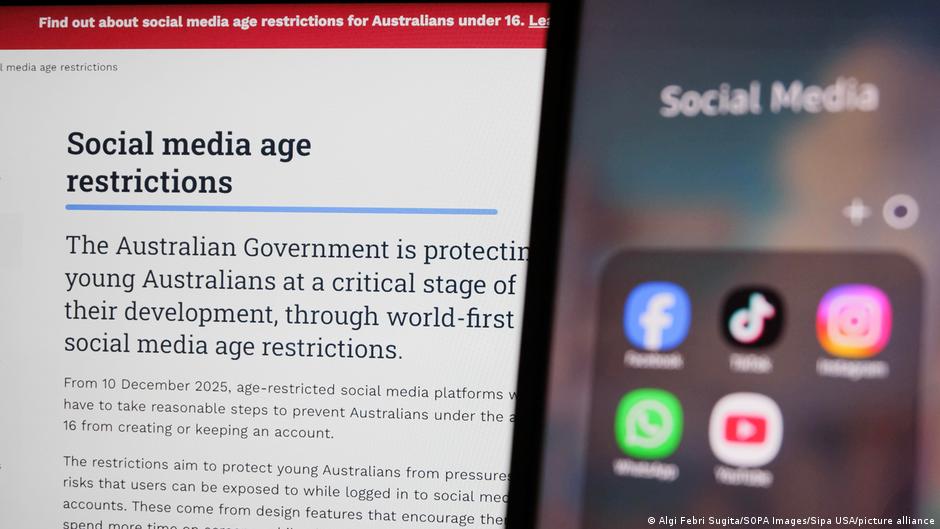
At midnight on Wednesday, Australians under the age of 16 were blocked from most social media sites, as the country introduced a world first ban. Despite their opposition to the plans, sites including Facebook, Instagram, Snapchat, TikTok, X, YouTube and Reddit will be age-restricted in a list that will be constantly updated. Online gaming and messaging sites such as WhatsApp will be unrestricted for now.
The Australian government are relying on the social media firms themselves to police the new law, saying they must take “reasonable steps” to prevent breaches, with punishments of up to AU $49.5 million (US $32 million, €27.5 million) for repeated offenses. Children or parents will not be punished should they break it.
The various ways in which platforms will be blocked will include users having to provide companies with government IDs, face or voice recognition or other forms of digital ID to prove their age when challenged.
The office of Australia’s eSafety Commissioner contends that the ban will protect young people “from pressures and risks that users can be exposed to while logged in to social media accounts.”
Prime Minister Anthony Albanese has called social media a “scourge” and said “I want people to spend more time on the footy field or the netball court than they’re spending on their phones.”
Polls have consistently shown overwhelming support for the ban from adults, but it’s a different story for the children directly affected.
Teenagers to challenge ban in court
Macy Newland, supported by rights campaign group the Digital Freedom Project, is challenging the law in Australia’s highest court with fellow teen Noah Jones on constitutional grounds. She told DW that most of her peers were against the ban, with concerns over a lack of consultation with young people and the loss of both rights and access to information at the forefront of their discontent.
“The ban stops young people from fully engaging in democracy and public discourse before they are 16, which is wrong. You cannot empower young people to engage in the public discourse and democracy by removing their ability to participate in it fully,” she said.
“I strongly believe that there are problems with social media, gaming and screen time in general. But there is no going back or denying that we live in a society where technology advancements are accelerating, and online communication is part of our everyday lives.”
Newland believes most teens will try to find ways to bypass the law, a position backed up by polling from national broadcaster ABC. The results of a survey of more than 17,000 Australian teens found that 75% will seek to avoid the ban, 9% think it’s a good idea and just 6% think it will work.
While there is a general acceptance that unchecked access to social media can be dangerous to both children and adults, most human rights and children’s advocacy organizations believe the new law does not address these issues.
Many children feel ignored by ‘blanket’ solution
The Australian arm of global children’s charity UNICEF says “the proposed changes won’t fix the problems young people face online” while the Australian Human Rights commission says the “blanket” ban is likely to also have “negative human rights impacts on children and young people.”
That was also what Kim Osman discovered. The researcher from the Digital Media Research Centre at the Queensland University of Technology spoke to 86 people aged between 12 and 15 about the ban. She too found they felt ignored and frustrated.
“Young people told us that they feel that their digital experiences are being homogenized by adults, and the very different ways they use social media aren’t being reflected in the national conversation they’re hearing,” Osman told DW. “They also felt that phone use is often conflated with social media use, when in fact social media is only one part of their digital lives.”
Over the course of her research, Osman and her colleagues also found that teenagers are aware of the dangers of social media and want better safeguarding solutions, including better content filtering.
There was, she said, also a strong sense that the law changes would lead to a “loss of community” for young people, particularly those who had “found important sources of support from social media. This is particularly true for the LGBTQAI+ and neurodivergent young people we spoke to.”
Children with disabilites feel isolated by ban
This strikes a chord with Jennifer Crowther. Her daughter, Lily, 12, has cerebral palsy, autism and other disabilities that mean socialization is not always easy. Having conversations is easier with the time afforded by messaging on social media and other messaging apps.
While Jennifer manages Lily’s access to social media, Lily has found a writing community online after having a story published and — while Jennifer acknowledges the dangers of social media — both feel frustration at the loss of connection that will take effect on Wednesday.
“For kids with disabilities or other marginalized groups, it [social media] could be their only pathway to find other people like them,” Jennifer told DW. “It’s such a small group of people, so how do they find them? That’s particularly true if they’re isolated because of their anxieties or because of how frequently they might be at appointments, or hospitalized or whatever the situation is.”
Lily’s writing has helped her begin to find a community through a Facebook page managed by her mum. Though the 12-year-old now does face to face events with likeminded people, the concern is that her means to maintain those emerging relationships and share her work are being eroded.
“The missing piece is that continued connection, which could happen through social media,” explained Jennifer. “Lily has met some other young people she wants to continue connecting with, but they live all over the state or internationally so that has been taken away.”
Teens and parents have also raised concerns that children will lose access to social media groups for more niche interests and hobbies and the communities these create. This is likely to be particularly keenly felt in rural Australia where populations are sparse and real-life connections are accordingly difficult to arrange.
Australia’s communications minister, Anika Wells, has admitted the ban will be “clunky” and “untidy” in its early stages. Given it’s pioneering nature, that is perhaps to be expected. But, for many Australian children and teenagers, frustrations with the ban stretch far beyond that.
Edited by: Carla Bleiker
