




Want to bookmark your favourite articles and stories to read or reference later? Start your Independent Membership today.
Join today
Already a member?
Log in
Sometimes it is as interesting to see an opera production once it has settled into a company’s bloodstream as it is to catch the premiere. At Covent Garden the current staging of Georges Bizet’s Carmen by Damiano Michieletto, revived by Dan Dooner, is in its third year in the house’s repertoire. It can also be seen at La Scala, Milan, and the Teatro Real in Madrid.
Michieletto’s basic premise works well, most of the time. He has updated the setting to roughly the Seventies or Eighties, with just a hint back to the spaghetti western, while keeping the sense of Mediterranean smuggling culture. Paolo Fantin’s sets are stark and deliberately uninviting and Carla Teti’s costumes functional for the men, mostly saucy for the women. Michieletto evokes strongly the tawdry violence and drink-fuelled sex of a working class and criminal subculture in a hot climate that propels the story.
There are occasional missteps. Micaëla (sung by Adriana Gonzalez), the girl sent to fetch the besotted Don José home to his elderly mother, does not need to be quite so dowdy. She should have enough homely allure to make his hesitation about following Carmen convincing, even if only for the moments they are together.
The performance on Tuesday 4 November is the fifth in this autumn’s run of nine in just under a month. It is also the third in consecutive days, normal for musicals in the West End, not for operas. This has consequences. The main parts are doubled up in these circumstances to avoid over-stretching voices but on this night the plans fall apart when both the intended Carmen (Ramona Zaharia) and Don José (Valentyn Ditiuk) call in sick.
Rather than bring in understudies (if there were any) the management ask the singers from Monday night, Ginger Costa-Jackson and Russell Thomas, to tackle their exhausting roles again without a rest day. This is tough. Costa-Jackson has an astonishing voice, rich enough to make every blast from Carmen formidable, but since her only register in this role seems to be full power, even she is sounding stressed by the end. Russell Thomas is tired, clearly, and it is noble of him to appear. That said, both portray their doomed and flawed characters with a conviction that is properly obsessive, though Thomas’s Don is so solid, mentally and physically, that Carmen’s brief fling with him seems rather too random.
There is excellence in abundance in the other parts. Alexander Vinogradov’s Escamillo, the bullfighter who would be Carmen’s natural partner, is gaudy in his golden suit and wide collared black shirt, sailing with suavity through his toreador boasts. Barnaby Rea is as revolting as he should be as Don José’s corrupt and lecherous colleague, Zuniga. Carmen’s two party-loving friends, Frasquita and Mercédès (Seohyun Go and Ellen Pearson) are compellingly naughty in garish hotpants. This opera is, after all, about women reacting to, but still acquiescing in, male power, with the fatal exception of Carmen herself.
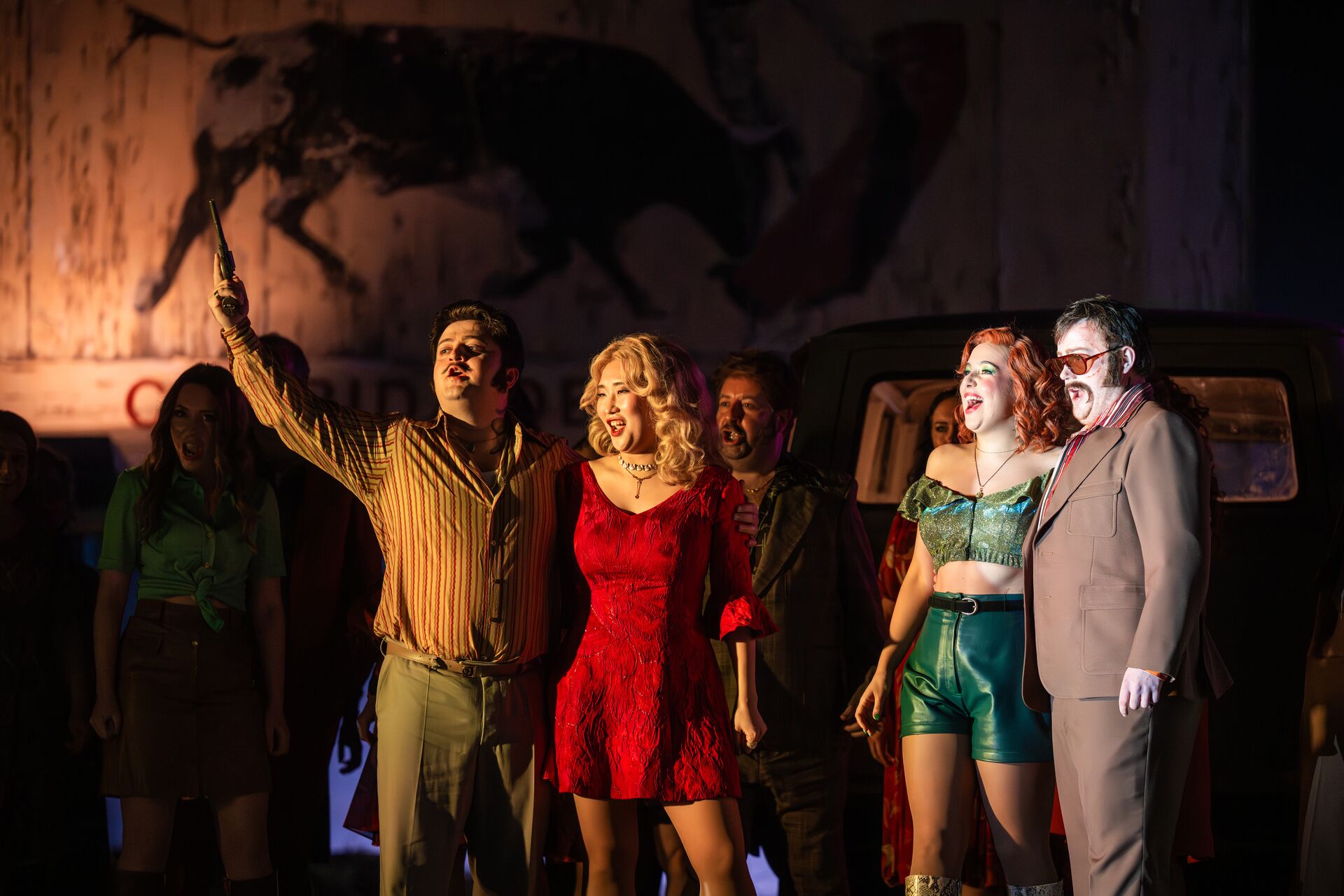
Just as much as on the main characters, Bizet’s opera depends on the chorus and orchestra and both are in good shape for the Royal Opera this season. Bizet relies on the flute section to carry many of his most beguiling tunes and moments of subtlety. The playing of them is immaculate and conductor Sesto Quatrino, brought up in the bel canto tradition with Fabio Luisi at my favourite Italian opera festival, Valle d’Itria in Puglia, allows the singers and orchestra soloists the time to develop their phrasing without too much rhythmic insistence.
This production revels in its chorus moments, whether the adult village and encampment crowd scenes or the witty mayhem of the children, here played with show-stealing energy by the Youth Opera Company. Whatever the emotional storms of the drama, it is the music for chorus and orchestra that lingers on the way home. There are two more performances this season – on 18 and 21 November.
