


China gets up to a fifth of its imported oil from Iran and another 4 to 5% from Venezuela, often through clandestine channels to skirt United States sanctions — or at least it did before recent disruptions.
US President Donald Trump’s move earlier this month to unseat Venezuela’s longtime leader, Nicolas Maduro, redirect its oil to the US and impose 25% tariffs on Iran-linked trade has raised serious questions about energy security in the world’s second-largest economy.
Oil prices briefly spiked on fears that China’s discounted Iranian supplies could be hit, while experts warned that US seizures of Venezuela-linked oil tankers may further constrict flows.
Can China’s domestic production fill the gap?
Beijing, meanwhile, has limited room to fall back on its domestic oil production to plug the gap.
As most of China’s imported oil runs through the narrow, congested Malacca Strait, Beijing has long treated the route as a strategic vulnerability. The Strait, which is patrolled by the US Navy, became a potential chokepoint during Trump’s first term as bilateral tensions escalated with Washington.
In 2019, President Xi Jinping ordered the ramping up of exploration and refining at home, launching the Seven-Year Action Plan and billions in new investments by China’s oil majors CNPC, Sinopec and CNOOC. Those gains, however, have been modest.
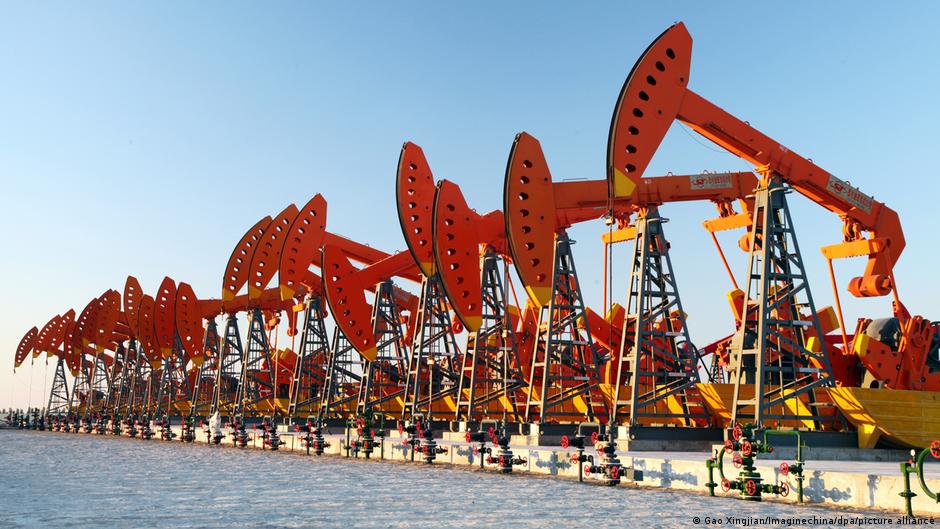
Domestic production rose from 3.8 million barrels per day (bpd) in 2018 to around 4.32 million bpd last year. However, even the growth from new wells, including tight shale fracking, [tight oil or shale is found in impermeable shale and limestone rock deposits — the ed.] could only offset the decline of China’s giant legacy fields, like Daqing in northeastern Heilongjiang Province and Shengli on the eastern Yellow River Delta.
June Goh, a Singapore-based senior oil market analyst at Sparta Commodities, said the cumulative output growth of 8.9% since 2021 is “huge,” surpassing Beijing’s target of the equivalent of 4 million barrels a day.
“The recent supply risk serves to prove that what they are doing is right,” Goh told DW. But she warned that further production growth was unlikely to be “exponential” as China’s oil majors are struggling to discover new reserves.
Other oil sector experts who have closely tracked China’s efforts to boost domestic production have described the situation more bluntly.
“[Despite] a huge amount of investment over the past 15 years or more,” output has largely been “running to stay still,” Lauri Myllyvirta, lead analyst of the Center for Research on Energy and Clean Air, told DW.
Myllyvirta said despite billions of yuan being poured into new oil wells, fracking and offshore projects, domestic oil production “has not budged.”
Oil stockpiles will help offset losses from Iran, Venezuela
With domestic output offering little upside, Beijing is leaning more on oil reserves. Since late 2023, Chinese policymakers significantly accelerated the expansion and filling of emergency stockpiles, known as strategic petroleum reserves (SPR). The move was fueled by growing geopolitical tensions following Russia’s full-scale invasion of Ukraine and a global surge in energy prices.
China was partly insulated after cutting deals with Iran and Russia to secure heavily discounted crude at below-market rates amid Western sanctions. Moscow became China’s top oil supplier until last year, when US sanctions on Russian firms and tankers caused a noticeable drop in flows.
Iran has since filled much of the gap, with nearly all of its exports — up to 2 million barrels per day at one point last year — delivered covertly to China via shadow fleets, ship-to-ship transfers and relabeling to disguise origins and evade tracking.
These stockpiles were increased further in 2025, Reuters news agency reported in October, with 11 new storage sites expected to be operational by early this year.
Goh thinks stockpiling rather than production increases will help China to further boost its energy independence amid likely falling supplies from Iran, Venezuela and Russia.
“China currently has 110 days of cover, which is higher than the OECD target of 90 days,” she said, referring to both the SPR and commercial reserves. “They have set a target of 180 days, so efforts to stockpile will now be accelerated given the geopolitical risks.”
Renewables, electrification emerge as the safer bet for China
While reserves provide immediate cushioning, longer-term resilience lies in the other measures China has pursued to strengthen energy security. These include rapid electrification and a record build-out of renewable energy.
Beijing has spent the past five years aggressively shifting oil-consuming sectors, including transport and heavy industry, toward electricity. Oil use in the transport sector peaked in 2023, China’s largest state oil producer, CNPC, reported last February. The country is upgrading its grid and building ultra-high-voltage lines to carry power from remote generation hubs to coastal industrial centers.
Electric vehicles (EV) now account for well over half of new car sales, and entire city bus fleets in Shenzhen, Guangzhou and dozens of provincial capitals have already gone fully electric. The rapid rollout of more than a million EV charging stations nationwide has helped cap growth in gasoline demand even as the economy expands.
In 2024 and 2025 alone, China added more solar capacity than the rest of the world combined, alongside record wind installations across Inner Mongolia, Xinjiang and coastal provinces.
“China’s wind and solar capacity growth has been more than 300 gigawatts per year over the past three years and is likely to have reached 400 gigawatts last year,” Myllyvirta noted.
Although these efforts can’t eliminate the country’s reliance on imported crude, they do blunt the impact of possible disruptions from heavily-sanctioned oil suppliers.
As China’s leaders prepare to unveil the next 5-year plan in March — the blueprint that will steer national economic and energy priorities until the early 2030s — further investments in domestic fossil fuel production, electrification and renewables are expected to feature heavily.
“For the next 5-year plan, China has a wide range of possible targets,” Myllyvirta said. “Combined with [additional oil] storage, maintaining that rate of renewable growth could substitute a lot of gas or coal in power generation. Electrification can replace all fossil fuels in industry, transportation and buildings.”
Edited by: Rob Mudge
