


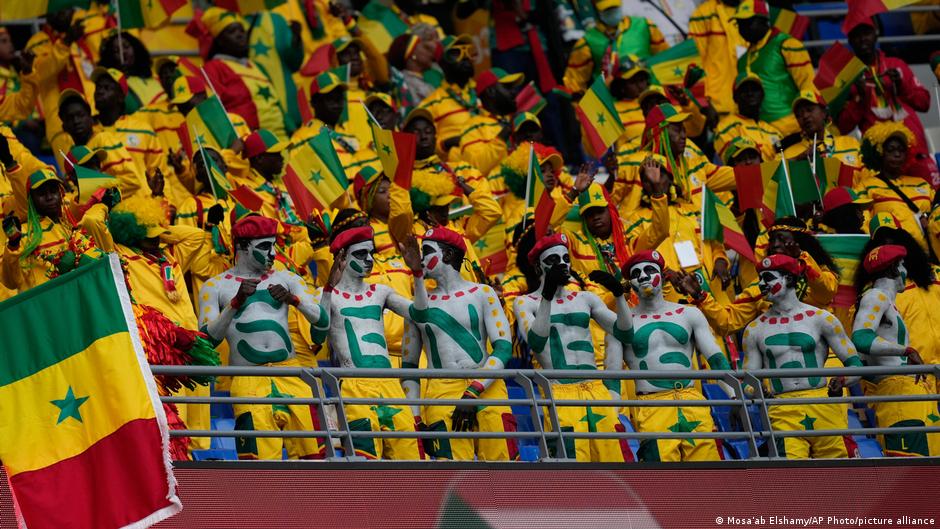
As soaked Senegal fans celebrated winning the Africa Cup of Nations in a Moroccan rainstorm on Sunday, thoughts and talk would likely have soon turned to a World Cup opener against France less than six months away.
The June 16 clash against their former colonial rulers, who Senegal memorably beat in the opening match of the 2002 World Cup, is in the New Jersey Stadium which will host the World Cup final. While the 300,000 strong Senegalese diaspora in France should ensure some fans are backing the African champions, those who hold only Senegalese passports will not be allowed in the US.
Senegal, like fellow AFCON participants Ivory Coast, were added last December to the list of countries banned from traveling to the US under a policy enacted by the Trump administration.
“I think it’s too strong. They’ve gone too far. The team can’t play without its supporters — and there are some really fervent supporters who accompany the team everywhere at all times,” Singom Dadji Ngam, a Senegal fan and social media personality, told DW during AFCON. “It only affects Senegalese who have just a Senegalese passport. But they are the ones who follow the team in all the qualifying matches.”
Four teams without traveling fans, more to follow?
The US has said the travel ban, which is lighter than that imposed on some countries, is because of a high overstay rate of about 4% for Senegal and 8% for Ivory Coast on B1 or B2 visitor visas, the type that would be used for a World Cup trip. Trump cited “screening and vetting deficiencies” as justification for the ban.
Aside from the two African sides, fans from fellow qualifiers Haiti and Iran will not be able to travel to the US, as they are subject to even more severe travel restrictions. The Democratic Republic of the Congo, also blacklisted, could yet qualify through the playoffs. Exceptions from the ban have been made for players and coaching staff, but not fans. A visa suspension for immigrants, rather than tourists, from 75 countries was also announced by the Trump administration last week. Senegal, Ivory Coast, Haiti, DR Congo and Iran are all among them.
Colombia and tournament co-hosts Mexico have also been recent targets of Trump’s ire, while Denmark’s reluctance to hand over Greenland to the US president may also make them a target should they qualify through the playoffs in March. Denmark’s group games will be played in co-host Mexico, in any case, but knockout matches could fall in the US.
Fans call for World Cup boycott
Tournament organizers FIFA, whose President Gianni Infantino has grown particularly close to Trump, have offered little in the way of assistance, stressing only that a match ticket “does not guarantee admission to a host country” in a recently-released statement. Nevertheless, the organizations claims it has received 500 million ticket applications from “all 211 FIFA Member Associations”, presumably including those who are banned from traveling.
But for those who have spent time, money and effort following their national team, geopolitics should not be the determining factor in whether they can follow their team.
One Senegal fan told DW he believes his country should boycott the tournament. “It’s something that needs to be done. I think that people should retain their dignity because if these competitions are successful it’s thanks to all those who take part in them, who give gas to them, who talk about them on social networks, who share them, who come to the matches to support their team,” he said.
“If we’re not accepted as supporters, our teams shouldn’t go and neither should we as supporters. We should boycott and the others who support us in this should boycott with us. We are the strength of these competitions. Without spectators, there’s no one. Without spectators, there is no sport, there is no entertainment.”
Ticket prices 5 times higher than Qatar
The cost of tickets is also a significant hurdle for fans from around the globe. Aside from a handful of tickets (less than 2% of the total allocation) belatedly offered to a small section of fans at low prices, prices are five times higher than the previous World Cup in Qatar in 2022.
Football Supporters Europe, a nonprofit members’ association of supporters, said excluding the tiny selection of reduced tickets, fans faced paying an average of just under €7,000 ($8,000) to get tickets for all of their team’s matches from the first game to the final. That’s roughly five times more than they would have paid to do so at the last tournament in Qatar.
“Football is a popular sport and it should be accessible to everyone. Paying for super-expensive tickets to watch a match isn’t something everyone can afford,” one Ivory Coast fan told DW in Morocco. “Disparities like this are not right. We’re really not happy because what Trump has done is disgraceful. It’s killing football.”
Edited by: Jonathan Harding
