


As part of the UNESCO-listed Museum Island, the Pergamon Museum is one of Berlin’s “must-see” attractions. But seeing it isn’t so easy: It has been completely closed for renovation since October 2023, and many parts will remain closed for 14 to 20 years — until 2037 to 2043.
However, some of the museum’s main highlights will be greeting visitors a decade before the rest of the building’s refurbishment is completed.
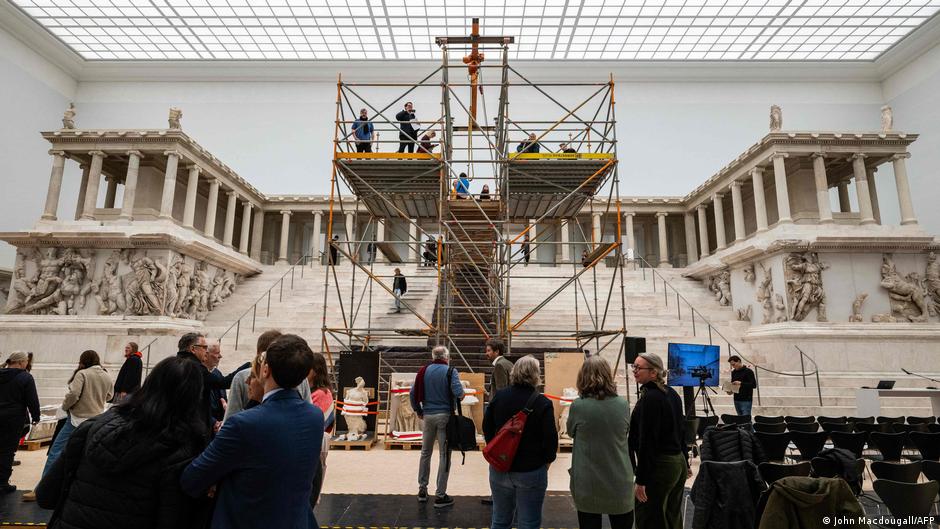
The north wing of the museum and the impressive Pergamon Altar hall, housing the famed Ancient Greek temple entrance for which the museum is named, are due to reopen in early 2027. The hall has been inaccessible since 2014.
A preview event for the press on December 4 provided insight into the museum’s monumental restoration project.
“This is a treasure of humanity,” noted Wolfram Weimer, federal government commissioner for culture and the media, at the presentation. “This will be a sensation. We’re not expecting hundreds of thousands of visitors here in the coming years; we’re expecting millions, because it’s designed as a location of global significance.”
Securing outdated structures
The Pergamon Museum was commissioned by German Emperor Wilhelm II and built from 1910 to 1930 according to plans by Alfred Messel. The museum’s restoration and additions follow many of the architect’s original designs.
The museum is a protected national heritage site, and the renovation preserves its main architectural attributes and original building techniques, as well as various elements such as the windows.
A few years after the Pergamon Museum opened in 1930, it was severely damaged during World War II, suffering from air raids and artillery fire.
After the war, the East Germany — where the museum was located — did not have the necessary funds to properly refurbish the building.
The current restoration process will preserve some traces of war damage as a testimony to the city’s history, while the parts that have naturally deteriorated over time are being repaired.
The lighting, climate control and security standards are being modernized to better conserve the millennia-old exhibits, and the entire museum is being made accessible to individuals with disabilities.
Unstable foundation, unexpected costs
The museum required significant reinforcement due to its location next to the Spree River on unstable, sandy ground. The foundations were anchored with more than 700 high-strength steel bars known as micropiles.
This led to an unexpected engineering challenge: While drilling 10 to 30 meters (30 to 100 feet) into the earth to install the micropiles, two pumping stations from the initial construction site were discovered. Built to drain groundwater, they were never completely dismantled, and the remains had been covered without being documented, leading to an unplanned step (and costs) in the restoration process.
The budget for this first phase of renovation has reached nearly €500 million ($580 million) — twice as much as initially estimated. The entire restoration project is planned to cost about €1.5 billion.
The highlights to be (re)discovered in 2027
So what treasures will once again be accessible to the public in 2027?
The monumental Pergamon Altar, excavated by Carl Humann in the ancient city of Pergamon (in present-day Turkey) in the 1870s, retains its own hall.
The original museum was custom-built around this temple structure dating back to the 2nd century BC. Decorated with a frieze in high relief depicting the battle between the Giants and the Olympian gods, the altar has been described in classical lists as one of the Seven Wonders of the Ancient World.
The space, more impressive than ever, is now flooded with light, as the ceiling’s glass elements have been completely renewed. A new protective roof structure, also made of glass, has been added above the hall.
As it would have been too complicated to remove the altar from the building during the refurbishment, its elements were kept within the room, protected by casings specially built for the restoration phase.
“It’s quite exceptional to build and renovate a building amid its existing collection,” Weimer noted.
However, other major exhibits were moved to new spaces.
Among them is the Mshatta Facade, a treasure of early Islamic art. It dates back to the era of the caliph Al-Walid II (743-744 AD) during the Umayyad period. Excavated in 1840 near Amman (the present-day capital of Jordan), the 33-meter-long (108-foot-long) palace facade was given by Ottoman Sultan Abdul Hamid II to Emperor Wilhelm II of Germany in 1903.
The Aleppo Room, a series of intricately painted wooden panels belonging to a reception room, was also cautiously dismantled during the renovation work and moved from the south wing to the north wing of the museum. The paintings, which have been splendidly renovated, merge Christian and Islamic iconography and were purchased in Aleppo in 1912.
The Alhambra Cupola, an intricately carved wooden dome dating back to the 14th century, was also temporarily relocated. Its post-renovation space will include various features designed to stimulate visitors’ senses, such as audio installations with poetry, as well as fragrance stations emitting odors related to the cedar and poplar wood dome’s origins.
The dome was acquired in 1885 from the famous former palace in the Alhambra, the historic citadel of Granada, Spain. Originally installed in a private house, it was donated to the Pergamon Museum nearly a century later.
A unique combination of Islamic Art and Antiquity
The Pergamon Museum’s collection is unusual in how it brings together Islamic Art and Ancient Greek treasures.
“What you see here is unique worldwide, namely that under one roof there are architectural styles from different ancient regions and times,” noted Marion Ackermann, director general of the Prussian Cultural Heritage Foundation, which oversees various museum collections including the Pergamon Museum, at the press presentation.
This concept, added Ackermann, was already established with the museum’s founding to mark the fact that its Antiquity exhibits had been excavated in Mesopotamia and eastern Mediterranean regions — the same regions where Islamic cultures developed.
“This simply shows once again that cultures never arise in complete isolation. They always exist through interaction with one another or in transcultural processes,” said Ackermann. “And that is, of course, a very contemporary and forward-looking way of thinking.”
Fans of world heritage can now look forward to discovering the meticulous and bright restoration of this museum — in spring 2027.
Edited by: Cristina Burack
