

News outlets in the US and around the world extensively cover the second administration of Donald Trump. Amid this flood of information on current events, film directors Demid Sheronkin and Can Dündar take a step back to assess the state of free speech and democracy in the US with their new DW documentary, “Democracy Under Attack: Can Dündar and Trump’s America,” which premiered on April 14 at the Human Rights Film Festival Berlin.
Dündar, a Turkish journalist and writer now living in exile in Berlin, pointed out at the film’s premiere that as they developed the project, they faced the challenge of finding an angle that could withstand Trump’s turbocharged news cycle.
“We decided to focus on the situation of the academics, as a kind of microcosm reflecting the attacks on democracy,” he explained.
Scholar faced death threats, doxxing and airport interrogations
Mark Bray, one of the university professors interviewed in the documentary, is among the most high-profile cases of academics targeted by the far right.
As the author of the book “Antifa: The Anti-Fascist Handbook,” the Rutgers University history professor was added to an online list of academics known as the “Professor Watchlist,” launched in 2016 by the far-right organization Turning Point USA.
After the assassination of the organization’s founder Charlie Kirk in September 2025, Trump signed an executive order designating the antifa movement as a “domestic terrorist organization.” From then on, death threats intensified against Bray, as students from the Turning Point USA chapter of his university denounced him for promoting political violence.
When Bray’s home address started circulating in his harassers’ emails, the scholar — who does not define himself as a member of the highly decentralized antifa movement — decided to uproot his family and relocate to Spain.
In the documentary, Bray and his wife describe the disturbing obstacles they faced before being finally able to leave the country — including their flight reservations to Spain being mysteriously canceled without them being informed.
AmericaFest: A surreal ideological battleground
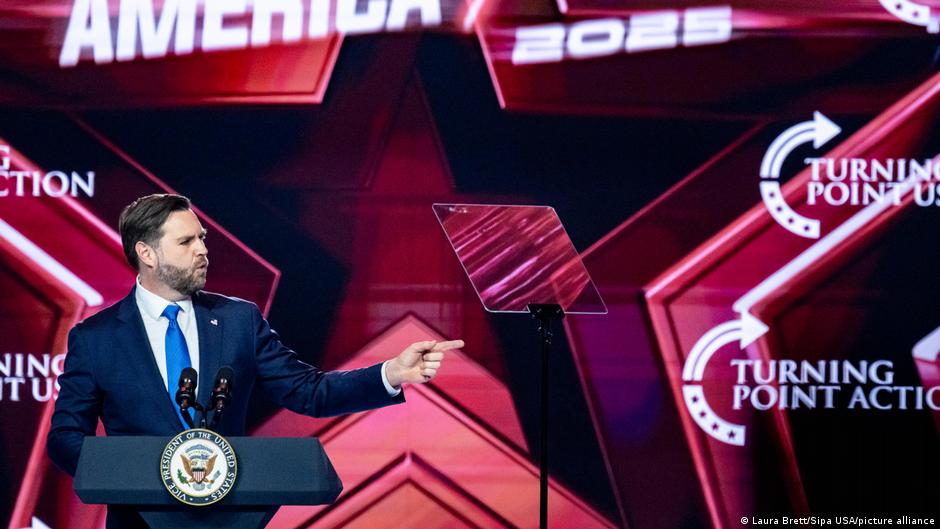
The most intense scenes in the documentary were shot at AmericaFest 2025, the first of Turning Point USA’s annual conventions to be held after Kirk’s death. The 30,000 attendees celebrated him like a martyr.
DW filmmaker Demid Sheronkin was unsettled by the event’s surreal atmosphere. “It felt like a blend of political rally and Christian service; a battleground and a festival.”
The documentary shows conservative speakers stirring up the MAGA crowd with one fiery speech after the other. “We are at war,” said former Trump adviser Steve Bannon. “We are in a political and ideological war.”
Ava Kwan, the Rutgers University student who petitioned to have Bray removed from his position, was also celebrated on stage like a star. Interviewed in the DW documentary, she said her initiative aimed to ensure the students’ safety. While she said she felt sorry Bray had to face death threats, she didn’t feel responsible for them, adding that she too ended up having her private information doxxed online.
But beyond the loaded atmosphere at the AmericaFest convention, the ideological divide can be felt everywhere in the country. Even though research shows that academics generally have a more liberal bent than the general public, the film offers a reminder that voices representing the far-right extreme of the political spectrum also exist among scholars.
Amy Wax, professor at the University of Pennsylvania Carey Law School, shares her white supremacist views in an interview in the documentary. Due to controversial statements, Wax was suspended at half pay and removed from teaching for the 2025-26 school year, but she did not lose her tenure.
Drawing lessons from firsthand oppression experience in Turkey
As the host of the film, Can Dündar draws lessons from the oppression he has experienced firsthand in his home country.
The Turkish investigative journalist became a global symbol of press freedom after being imprisoned for his reporting. He survived an assassination attempt and was ultimately forced into exile from his home country, landing in Berlin in 2016.
Considered a fugitive by Turkish authorities, Dündar did not travel to the US for the documentary project, following the advice of his lawyers. “I didn’t want to become a good gift of Trump to Erdogan,” he noted.
But Dündar did travel to Canada for another interview. Even there, authorities interrogated him for several hours upon his arrival, due to his “terrorist” label. In Toronto, he met another expert on fascism who decided to flee Trump’s America, Yale philosophy professor Jason Stanley.
Stanley, whose parents were Holocaust survivors, is very pessimistic in his assessment of the situation: “The US is not in a temporary crisis. The US is over as a project.”
For Dündar, the warning signs should definitely be taken seriously. “I feel like a new wave of authoritarianism was tested in Turkey, and it’s now spreading all over the world; I can smell it, I can feel it,” Dündar told DW. “We are seeing the same kind of signs: destruction of rule of law, attacks on media freedom … those are the starters.”
The worrying developments in the US mirror what has already happened in Turkey, the journalist added. “That’s why I want to say ‘be careful,’ because the rest is really very painful.” Dündar noted that Europeans need to be more alert too. “Democracy shouldn’t be taken for granted.”
Edited by: Brenda Haas
